Category Archives: How to Fix

When react devtools is enabled, an error is reported for the project

I installed the latest version of react devtools on the V3 branch. I installed it according to a series of operations in the official documents, and then ran the project to report an error:

However, the previous project was running normally, so I searched the Internet and found that most of them said that the plug-in react devtools was disabled directly, and there was no language. Why do I install it??Too much memory??

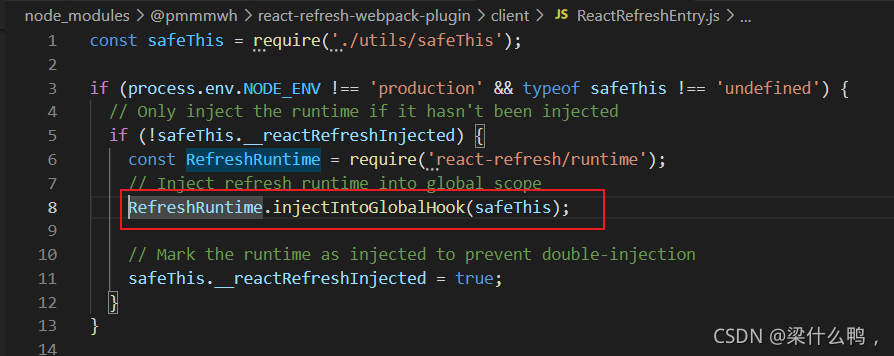
So I looked at the error message again, and then commented out the code used in my project according to the following error message

according to its path, and then re yarn start, there was no error message

I read it online and said that this is the reason for the version. I said that the previous version did not have this problem
just sauce, bye!

UOS LTP compilation ustat test item error

environmental information

$ dpkg -l|grep libc6-dev
ii  libc6-dev:mips64el  2.28.12-1+eagle    mips64el  GNU C Library: Development Libraries and Header Files

Error message

~ltp/testcases/kernel/syscalls/ustat$ make
In file included from ../../../../include/tst_test.h:14,
                 from ustat01.c:9:
/usr/include/mips64el-linux-gnuabi64/bits/ustat.h:24:8: error: redefinition of ‘struct statfs’
 struct ustat
        ^~~~~

It shows that the struct ustat is repeatedly defined.

analysis

In the normal environment, the struct ustat structure is not defined. If you want to use this structure, you need to define it yourself. LTP also provides a custom struct ustat structure
where lapi/ustat. H is defined as follows:

//SPDX-License-Identifier: GPL-2.0-or-later

#ifndef LAPI_USTAT_H__
#define LAPI_USTAT_H__

#include "config.h"
#include <sys/types.h>
#ifdef HAVE_SYS_USTAT_H
# include <sys/ustat.h>
#elif HAVE_LINUX_TYPES_H
# include <linux/types.h>
struct ustat {
        __kernel_daddr_t f_tfree;
        ino_t f_tinode;
        char f_fname[6];
        char f_fpack[6];
};
#endif

#endif /* LAPI_USTAT_H__ */

The header file in the test code contains lapi/ustat. H, so the test code is OK.

#include "config.h"
#include "tst_test.h"

#if defined(HAVE_SYS_USTAT_H) || defined(HAVE_LINUX_TYPES_H)
#include <unistd.h>
#include <errno.h>
#include <sys/types.h>
#include <sys/stat.h>

#include "lapi/syscalls.h"
#include "lapi/ustat.h"

According to the error message, it is displayed in… /… /… /…/include/TST_ Test. H: line 14 of 14.

	...
 14 #include <unistd.h>
	 ...

Line 14 is the header file unistd. H, which is the file of libc6 dev package
file content:

...
/* Move FD's file position to OFFSET bytes from the
   beginning of the file (if WHENCE is SEEK_SET),
   the current position (if WHENCE is SEEK_CUR),
   or the end of the file (if WHENCE is SEEK_END).
   Return the new file position.  */


#define llseek lseek     
#define ustat statfs
#ifndef __USE_FILE_OFFSET64
extern __off_t lseek (int __fd, __off_t __offset, int __whence) __THROW;
#else
...

There are macro definitions

#define ustat statfs

Simply replacing statfs with ustat leads to the problem of repeatedly defining struct ustat.

Conclusion

After investigation, unistd. H belongs to libc6 dev. the version installed in the current environment is 2.28.12-1 + eagle. These two macros are not added to unistd. H in 2.28.10 and 2.28.14.

#define llseek lseek     
#define ustat statfs

It is speculated that UOS may have modified the source code of glibc. The record of adding these two macros in unistd. H was not found in the public glibc.

Gateway forwards weboskct with an error ClassCastException

    usage environment: the springcloud gateway forwards an error message to the websocket. Error message content:

    15:30:38.092 [http-nio-9999-exec-1] ERROR c.m.g.e.GlobalErrorWebExceptionHandler - [handle,38] - org.apache.catalina.connector.ResponseFacade cannot be cast to reactor.netty.http.server.HttpServerResponse
    java.lang.ClassCastException: org.apache.catalina.connector.ResponseFacade cannot be cast to reactor.netty.http.server.HttpServerResponse
    	at org.springframework.web.reactive.socket.server.upgrade.ReactorNettyRequestUpgradeStrategy.getNativeResponse(ReactorNettyRequestUpgradeStrategy.java:182)
    	Suppressed: reactor.core.publisher.FluxOnAssembly$OnAssemblyException: 
    Error has been observed at the following site(s):
    	|_ checkpoint ⇢ org.springframework.cloud.gateway.filter.WeightCalculatorWebFilter [DefaultWebFilterChain]
    	|_ checkpoint ⇢ org.springframework.boot.actuate.metrics.web.reactive.server.MetricsWebFilter [DefaultWebFilterChain]
    	|_ checkpoint ⇢ HTTP GET "/sys/websocket/1" [ExceptionHandlingWebHandler]
    Stack trace:
    		at org.springframework.web.reactive.socket.server.upgrade.ReactorNettyRequestUpgradeStrategy.getNativeResponse(ReactorNettyRequestUpgradeStrategy.java:182)
    		at org.springframework.web.reactive.socket.server.upgrade.ReactorNettyRequestUpgradeStrategy.upgrade(ReactorNettyRequestUpgradeStrategy.java:162)
    		at org.springframework.web.reactive.socket.server.support.HandshakeWebSocketService.lambda$handleRequest$1(HandshakeWebSocketService.java:235)
    		at reactor.core.publisher.FluxFlatMap.trySubscribeScalarMap(FluxFlatMap.java:151)
    		at reactor.core.publisher.MonoFlatMap.subscribeOrReturn(MonoFlatMap.java:53)
    		at reactor.core.publisher.InternalMonoOperator.subscribe(InternalMonoOperator.java:57)
    		at reactor.core.publisher.MonoDefer.subscribe(MonoDefer.java:52)
    		at reactor.core.publisher.MonoDefer.subscribe(MonoDefer.java:52)
    		at reactor.core.publisher.MonoDefer.subscribe(MonoDefer.java:52)
    		at reactor.core.publisher.MonoDefer.subscribe(MonoDefer.java:52)
    		at reactor.core.publisher.InternalMonoOperator.subscribe(InternalMonoOperator.java:64)
    		at reactor.core.publisher.MonoDefer.subscribe(MonoDefer.java:52)
    		at reactor.core.publisher.MonoDefer.subscribe(MonoDefer.java:52)
    		at reactor.core.publisher.Mono.subscribe(Mono.java:4252)
    		at reactor.core.publisher.MonoIgnoreThen$ThenIgnoreMain.drain(MonoIgnoreThen.java:172)
    		at reactor.core.publisher.MonoIgnoreThen.subscribe(MonoIgnoreThen.java:56)
    		at reactor.core.publisher.InternalMonoOperator.subscribe(InternalMonoOperator.java:64)
    		at reactor.core.publisher.MonoDefer.subscribe(MonoDefer.java:52)
    		at reactor.core.publisher.MonoDefer.subscribe(MonoDefer.java:52)
    		at reactor.core.publisher.MonoDefer.subscribe(MonoDefer.java:52)
    		at com.alibaba.csp.sentinel.adapter.reactor.MonoSentinelOperator.subscribe(MonoSentinelOperator.java:40)
    		at reactor.core.publisher.MonoDefer.subscribe(MonoDefer.java:52)
    		at reactor.core.publisher.InternalMonoOperator.subscribe(InternalMonoOperator.java:64)
    		at reactor.core.publisher.MonoDefer.subscribe(MonoDefer.java:52)
    
      cause of error: dependency conflict
      the Tomcat servlet of springboot is used in the request and the Tomcat of gateway netty is used in the response, so the type conversion exception is caused. Solution: modify the gateway POM file:
      delete or exclude the following dependencies

      <dependency>
      	<groupId>javax.servlet</groupId>
      	<artifactId>javax.servlet-api</artifactId>
      </dependency>
       <dependency>
          <groupId>org.springframework.boot</groupId>
          <artifactId>spring-boot-starter-web</artifactId>
       </dependency>
       <dependency>
      	<groupId>javax.servlet</groupId>
      	<artifactId>jstl</artifactId>
      </dependency>
      <dependency>
      	<groupId>org.apache.tomcat.embed</groupId>
      	<artifactId>tomcat-embed-jasper</artifactId>
      </dependency>
      

[Solved] hiveonspark:Execution Error, return code 30041 from org.apache.hadoop.hive.ql.exec.spark.SparkTask

Problem Description:
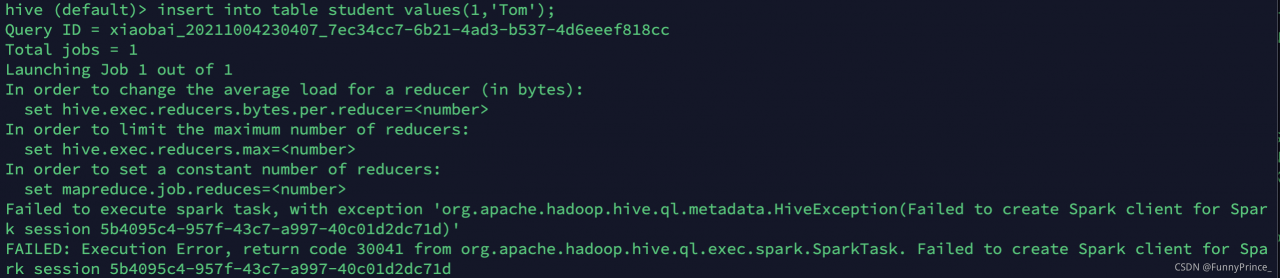
when deploying hive on spark, the test reports an error, and the table creation operation is successful, but the following error occurs when inserting insert:

Failed to execute spark task, with exception ‘org.apache.hadoop.hive.ql.metadata.HiveException(Failed to create Spark client for Spark session 2df0eb9a-15b4-4d81-aea1-24b12094bf44)’
FAILED: Execution Error, return code 30041 from org.apache.hadoop.hive.ql.exec.spark.SparkTask. Failed to create Spark client for Spark session 2df0eb9a-15b4-4d81-aea1-24b12094bf44

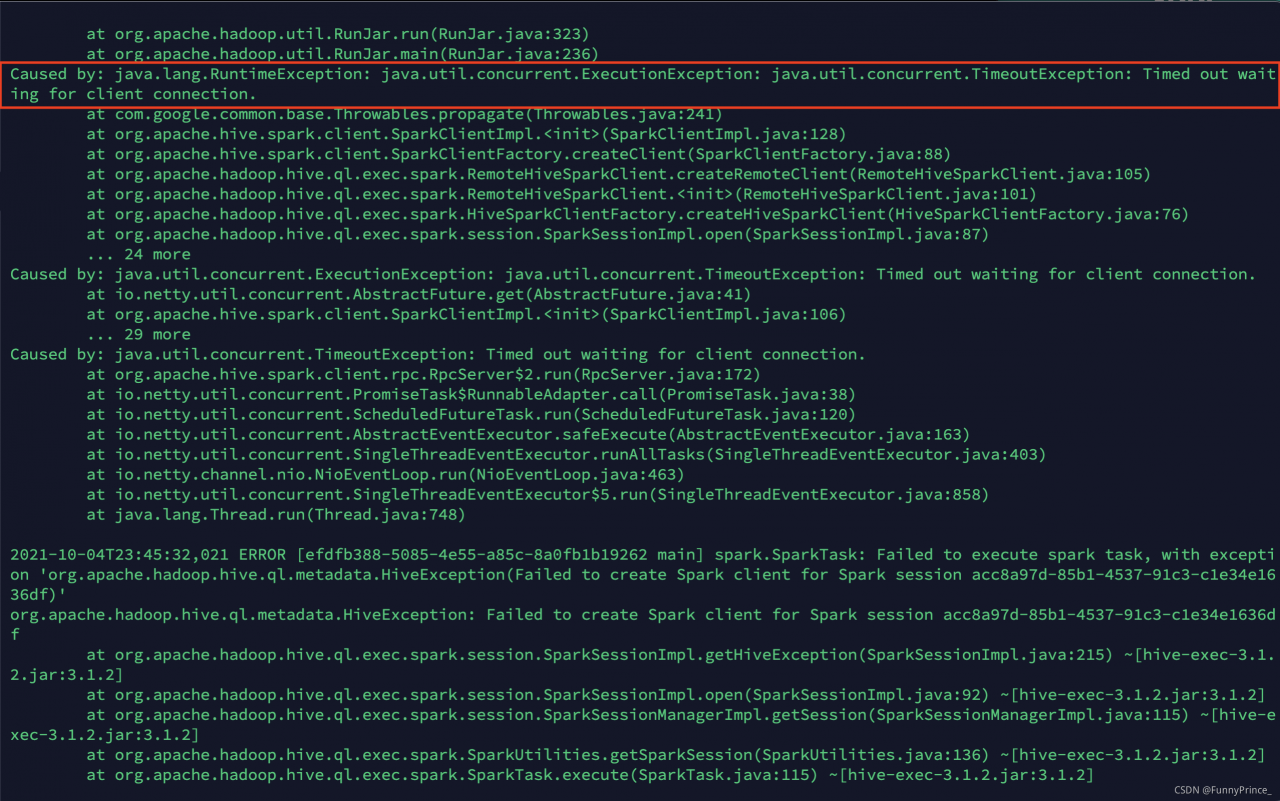
View the hive log according to the required time in the/TMP/Xiaobai path:

cause analysis
prompt timed out waiting for client connection. Indicates that the connection time between hive and spark has timed out

Solution
1). Change the spark-env.sh.template file in/opt/module/spark/conf/directory to spark env. Sh , and then add the content export spark_ DIST_ CLASSPATH=$(hadoop classpath)
2). Change hive-site.xml in/opt/module/hive/conf directory to modify the connection time between hive and spark

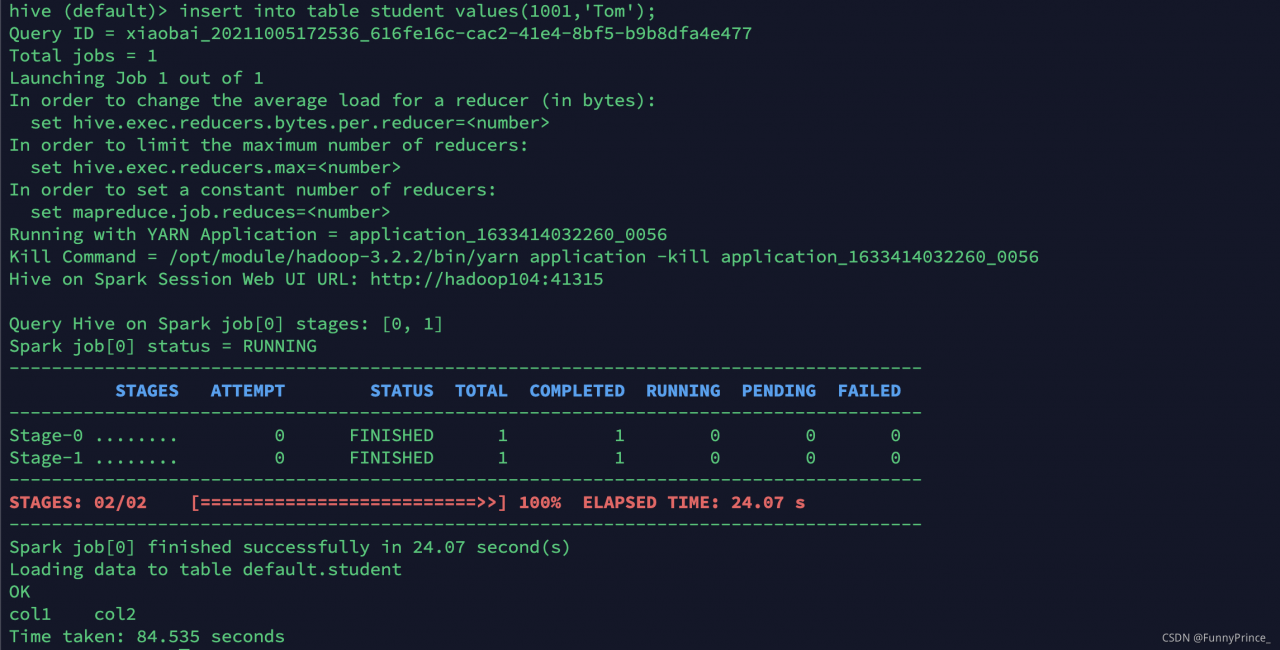
execute the insert statement again. Success! Cry with joy

I made a mistake last night. I checked it all night and didn’t solve it. As a result, I solved it today.

Error command failed when creating vue-cli4 project: Yarn

Error reported when creating Vue item: error command failed: Yarn

Solution 1: Win + R enter CMD to enter the command line interface

Enter command

npm install -g yarn

After success, the problem can be solved by re creating vue-cli4 project.

Solution 2:

Enter C:/users/administrator/in the windows environment

There is a file. Vuerc


Open this file to display

{
  "useTaobaoRegistry": true,
  "packageManager": "yarn"
}

Just manually change the configuration content yarn to NPM to change the package manager when the project is created

Solution 3:

Delete the. Vuerc file. When you create a Vue project for the first time, you will be prompted to select the configuration, and then select NPM
 

RuntimeError: Expected hidden[0] size (x, x, x), got(x, x, x)

Start with the above figure:
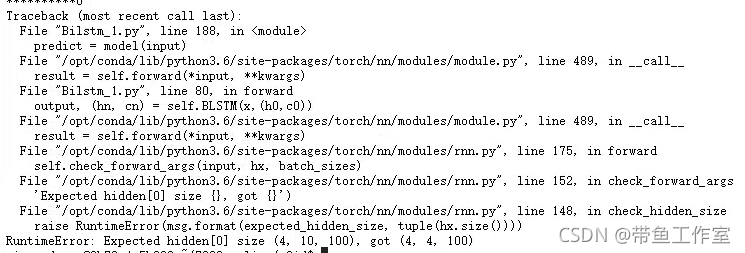
The above figure shows the problem when training the bilstm network.

Problem Description: define the initial weights H0 and C0 of bilstm network and input them to the network as the initial weight of bilstm, which is realized by the following code

output, (hn, cn) = self.bilstm(input, (h0, c0))

  The network structure is as follows:

self.bilstm = nn.LSTM(
            input_size=self.input_size,
            hidden_size=self.hidden_size,
            num_layers=self.num_layers,
            bidirectional=True,
            bias=True,
            dropout=config.drop_out
        )

The dimension of initial weight is defined as   H0 and C0 are initialized. The dimension is:

**h_0** of shape `(num_layers * num_directions, batch, hidden_size)`
**c_0** of shape `(num_layers * num_directions, batch, hidden_size)`

In bilstm network, the parameters are defined as follows:

num_layers: 2

num_directions: 2

batch: 4

seq_len: 10

input_size: 300

hidden_size: 100 

Then according to the definition in the official documents    H0, C0 dimensions should be: (2 * 2, 4100) = (4, 4100)

However, according to the error screenshot at the beginning of the article, the dimension of the initial weight of the hidden layer should be (4, 10100), which makes me doubt whether the dimension specified in the official document is correct.

Obviously, the official documents cannot be wrong, and the hidden state dimensions when using blstm, RNN and bigru in the past are the same as those specified by the official, so I don’t know where to start.

Therefore, we re examined the network structure and found that an important parameter, batch, was missing_ First, let’s take a look at all the parameters required by bilstm:

Args:
        input_size: The number of expected features in the input `x`
        hidden_size: The number of features in the hidden state `h`
        num_layers: Number of recurrent layers. E.g., setting ``num_layers=2``
            would mean stacking two LSTMs together to form a `stacked LSTM`,
            with the second LSTM taking in outputs of the first LSTM and
            computing the final results. Default: 1
        bias: If ``False``, then the layer does not use bias weights `b_ih` and `b_hh`.
            Default: ``True``
        batch_first: If ``True``, then the input and output tensors are provided
            as (batch, seq, feature). Default: ``False``
        dropout: If non-zero, introduces a `Dropout` layer on the outputs of each
            LSTM layer except the last layer, with dropout probability equal to
            :attr:`dropout`. Default: 0
        bidirectional: If ``True``, becomes a bidirectional LSTM. Default: ``False``

batch_ The first parameter can make the dimension batch in the first dimension during training, that is, the input data dimension is

(batch size, SEQ len, embedding dim), if not added   batch_ First = true, the dimension is

(seq len,batch size,embedding dim)

Because there was no break at noon, I vaguely forgot to add this important parameter, resulting in an error: the initial weight dimension is incorrect, and I can add it   batch_ Run smoothly after first = true.

The modified network structure is as follows:

self.bilstm = nn.LSTM(
            input_size=self.input_size,
            hidden_size=self.hidden_size,
            num_layers=self.num_layers,
            batch_first=True,
            bidirectional=True,
            bias=True,
            dropout=config.drop_out
        )


Extension: when we use RNN and its variant network, if we want to add the initial weight, the dimension must be the officially specified dimension, i.e

(num_layers * num_directions, batch, hidden_size)

At the same time, be sure to set batch_ First = true. The official document does not specify when batch is set_ When first = true, the dimensions of H0, C0, HN and CN are (num_layers * num_directions, batch, hidden_size), so be careful!

At the same time, check whether batch is set when the dimensions of HN and CN are incorrect_ First parameter, RNN and its variant networks are applicable to this method!


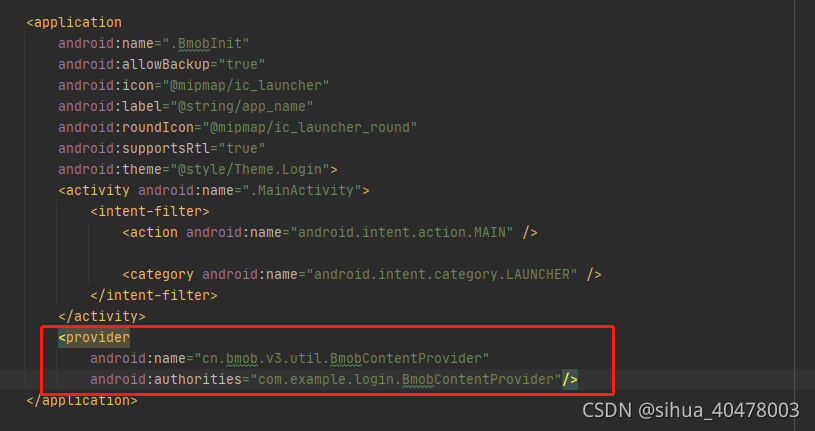
errorCode:9015,errorMsg:cn.bmob.v3.util.BmobContentProvider.updateProvider(BmobContentProvider.java:

About the 9015 null pointer in the bmob backend cloud service platform, I checked it online. The reason is very simple, that is, it does not operate according to the official documents. Although the data can still be transmitted normally, it is still annoying to open the app with a prompt pop-up window.

Solution:

Directly open androidmanifest.xml and add two lines of code

        <provider
            android:name="cn.bmob.v3.util.BmobContentProvider"
            android:authorities="com.example.login.BmobContentProvider"/>

If I can help you, just give me a favor!!!   Thank you from the majority of hard pressed programmers!

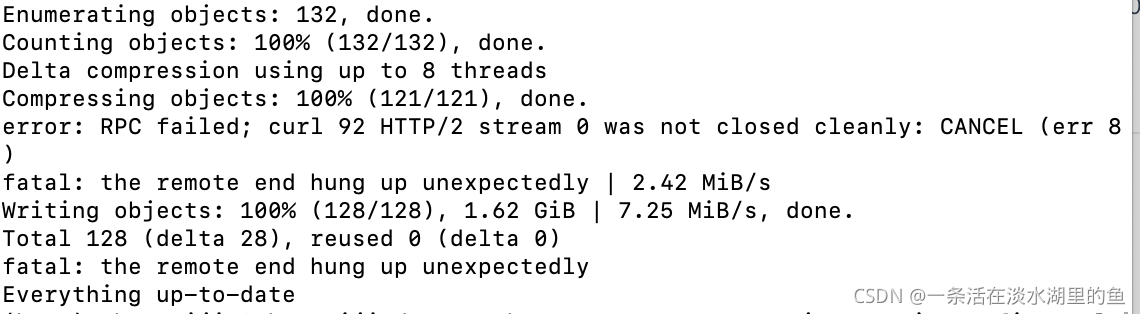
error: RPC failed; curl 92 HTTP/2 stream 0 was not closed cleanly: CANCEL (err 8)

When uploading code to GitHub using git, the following error occurs:

It is true that there is a large amount of code uploaded at one time, and then expand the post buffer according to the scheme provided on the Internet, but it has no effect here. Maybe the buffer is not large enough, HHH. You can try this plan first.

git config http.postBuffer 524288000

Then, if it has not been solved, try the following scheme. We can see that the error message refers to http/2, so the solution is to switch back to http1 upload. After uploading, switch back to http2.

$ git config --global http.version HTTP/1.1
After it push was ok and I have changed HTTP version to 2 again:
$ git config --global http.version HTTP/2

However, things were always so bad, so I tried to switch to SSH connection.

git remote set-url origin [email protected]:{username}/{repository name}.git

However

Looking at this line of red and yellow characters, I knew early in the morning that the file was too large, but the above methods didn’t work here. Fortunately, GIT LFS was mentioned in the error prompt. OK, Download git LFS.

For Mac users:

brew install git-lfs

  Then, under the project directory, execute:

git lfs install

Then, use git LFS to track the format of the large file you want to upload. What I upload here is in Bin format, so execute:

git lfs track "*.bin"

Then make sure  . Gitattributes tracked to

git add .gitattributes

Then upload it

Kvm internal error: process exited :cannot set up guest memory ‘pc.ram‘:Cannot allocate memory

An error message indicates that the memory is insufficient and cannot be allocated. Check that the physical machine memory is used normally. After modifying the virtual machine memory, an error message is still reported when starting

report errors:

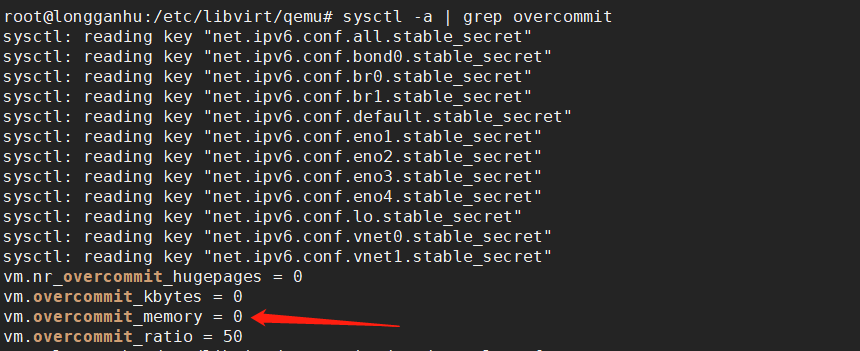
At this time, you need to see how much memory the host can allocate

sysctl -a | grep overcommit

Kernel parameter overcommit_ memory  

It is   Memory allocation strategy

Optional values: 0, 1, 2
0 indicates that the kernel will check whether there is enough available memory for processes to use; If there is enough available memory, the memory application is allowed; Otherwise, the memory request fails and the error is returned to the application process
1 indicates that the kernel is allowed to allocate all physical memory regardless of the current memory state
2 indicates that the kernel allows to allocate more memory than the sum of all physical memory and swap space

What are overcommit and oom

     Linux replies “yes” to most requests for memory so that it can run more and larger programs. Because after applying for memory, memory will not be used immediately. This technology is called overcommit. When Linux finds that there is insufficient memory, an oom killer (OOM = out of memory) occurs. It will choose to kill some processes (user state processes, not kernel threads) to free memory.

     When oom killer happens, which processes will Linux choose to kill?The function to select a process is oom_ Badness function (in mm/oom_kill. C), which calculates the number of points (0 ~ 1000) for each process. The higher the number of points, the more likely the process is to be killed. The number of points per process is the same as oom_ score_ Adj related, and OOM_ score_ Adj can be set (- 1000 min, 1000 max).

resolvent:

      Simply follow the prompts (set vm.overcommit_memory to 1):

      There are three ways to modify kernel parameters, but with root permission:

    (1) Edit/etc/sysctl.conf to vm.overcommit_ Memory = 1, then sysctl – P makes the configuration file effective

  (2)sysctl vm.overcommit_ memory=1

  (3)echo 1 >/proc/sys/vm/overcommit_ memory