Problem: using jsoup to parse a web page reports an error null exception

solve:
Set request header to bypass login

Parsing succeeded

Problem: using jsoup to parse a web page reports an error null exception
solve:
Set request header to bypass login
Parsing succeeded
Error message:
CMake Error: CMake was unable to find a build program corresponding to "Ninja". CMAKE_MAKE_PROGRAM is not set. You probably need to select a different build tool.
terms of settlement:
sudo apt-get install ninja-build
Problem Description:
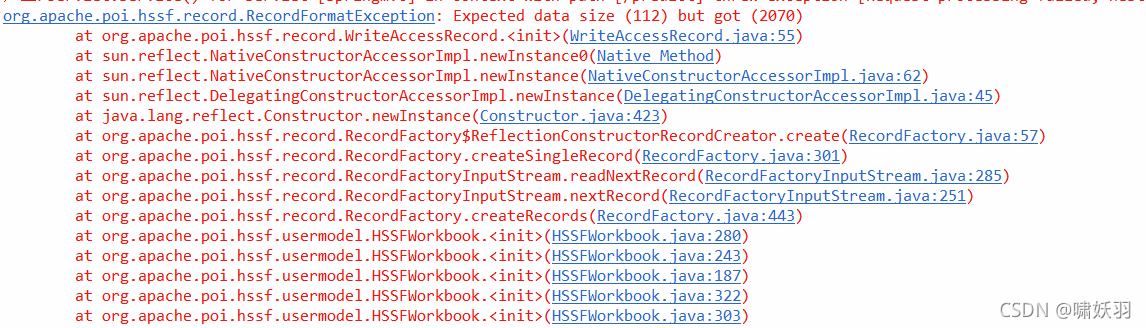
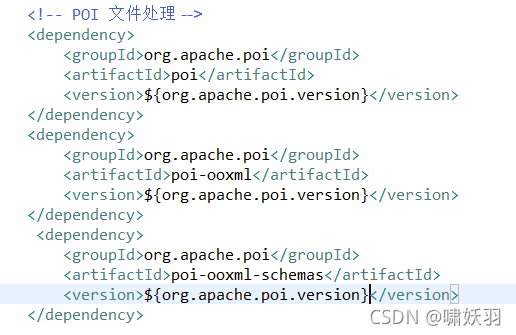
The excel table with. XLS suffix uploaded by POI version 3.9 will report an error, as shown in the following figure. However, if you open an excel table and add a row, then delete it and save it, you will not report an error if you upload it again.
Use JSTL to report an error when traversing the list set
javax.el.PropertyNotFoundException: Property [department] not found on type [com.studying.model.Employee]
However, the Department attribute in the data transmitted from the back end has a value

Error reason
After careful search, it is found that the set/get method of attribute Department has been forgotten in the employee class
    public Department getDepartment() {
        return department;
    }

    public void setDepartment(Department department) {
        this.department = department;
    }
1. The error information is as follows:
$ sudo pip install bs4==0.0.1
Collecting bs4==0.0.1
  Downloading http://pip.pgw.getui.com/packages/10/ed/7e8b97591f6f456174139ec089c769f89a94a1a4025fe967691de971f314/bs4-0.0.1.tar.gz
Collecting beautifulsoup4 (from bs4==0.0.1)
  Downloading http://pip.pgw.getui.com/packages/a1/69/daeee6d8f22c997e522cdbeb59641c4d31ab120aba0f2c799500f7456b7e/beautifulsoup4-4.10.0.tar.gz (399kB)
    100% |████████████████████████████████| 409kB 11.7MB/s
    Complete output from command python setup.py egg_info:
    Traceback (most recent call last):
      File "<string>", line 1, in <module>
      File "/tmp/pip-build-USqeae/beautifulsoup4/setup.py", line 7, in <module>
        from bs4 import __version__
      File "bs4/__init__.py", line 36, in <module>
        raise ImportError('You are trying to use a Python 3-specific version of Beautiful Soup under Python 2. This will not work. The final version of Beautiful Soup to support Python 2 was 4.9.3.')
    ImportError: You are trying to use a Python 3-specific version of Beautiful Soup under Python 2. This will not work. The final version of Beautiful Soup to support Python 2 was 4.9.3.

    ----------------------------------------
Command "python setup.py egg_info" failed with error code 1 in /tmp/pip-build-USqeae/beautifulsoup4/
2 solution
Install beatifulsoup4 first
$ sudo  pip install beautifulsoup4==4.9.0
Collecting beautifulsoup4==4.9.0
  Downloading http://pip.pgw.getui.com/packages/2d/3e/8b2fc5d3c31c84d7209313f4059858f502f2e4a9d986693eca03fe325565/beautifulsoup4-4.9.0-py2-none-any.whl (109kB)
    100% |████████████████████████████████| 112kB 872kB/s
Collecting soupsieve<2.0 (from beautifulsoup4==4.9.0)
  Downloading http://pip.pgw.getui.com/packages/39/36/f35056eb9978a622bbcedc554993d10777e3c6ff1ca24cde53f4be9c5fc4/soupsieve-1.9.6-py2.py3-none-any.whl
Collecting backports.functools-lru-cache; python_version < "3" (from soupsieve<2.0->beautifulsoup4==4.9.0)
  Downloading http://pip.pgw.getui.com/packages/e5/c1/1a48a4bb9b515480d6c666977eeca9243be9fa9e6fb5a34be0ad9627f737/backports.functools_lru_cache-1.6.4-py2.py3-none-any.whl
Installing collected packages: backports.functools-lru-cache, soupsieve, beautifulsoup4
Successfully installed backports.functools-lru-cache-1.6.4 beautifulsoup4-4.9.0 soupsieve-1.9.6
Installing BS4
$ sudo  pip install  bs4==0.0.1
Collecting bs4==0.0.1
  Downloading http://pip.pgw.getui.com/packages/10/ed/7e8b97591f6f456174139ec089c769f89a94a1a4025fe967691de971f314/bs4-0.0.1.tar.gz
Requirement already satisfied (use --upgrade to upgrade): beautifulsoup4 in /usr/lib/python2.7/site-packages (from bs4==0.0.1)
Requirement already satisfied (use --upgrade to upgrade): soupsieve<2.0 in /usr/lib/python2.7/site-packages (from beautifulsoup4->bs4==0.0.1)
Requirement already satisfied (use --upgrade to upgrade): backports.functools-lru-cache; python_version < "3" in /usr/lib/python2.7/site-packages (from soupsieve<2.0->beautifulsoup4->bs4==0.0.1)
Installing collected packages: bs4
  Running setup.py install for bs4 ... done
Successfully installed bs4-0.0.1Class JavaLaunchHelper is implemented in both /Library/Java/JavaVirtualMachines/jdk1.8.0_ 144.jdk/Contents/Home/bin/java (0x10dd324c0) and /Library/Java/JavaVirtualMachines/jdk1.8.0_ 144.jdk/contents/home/jre/lib/libinstrument.dylib error
To solve the problem, you need to set the idea custom properties. Click Help on the navigation bar and select Edit custom properties,
For the first time, there is no properties file. At this time, the following interface will pop up in idea to prompt you to create it. Click Create directly.
Write idea. No. launcher = true in idea.properties, and then restart idea.
Download a file from git, open it, run fluent pub get, and an error occurs:
pubspec.yaml has no lower bound SDK constraint.
you should edit pubspec.yaml to contain an SDK constraint:
environment:
SDK: ‘>= 2.10.0 < 3.0.0 ‘
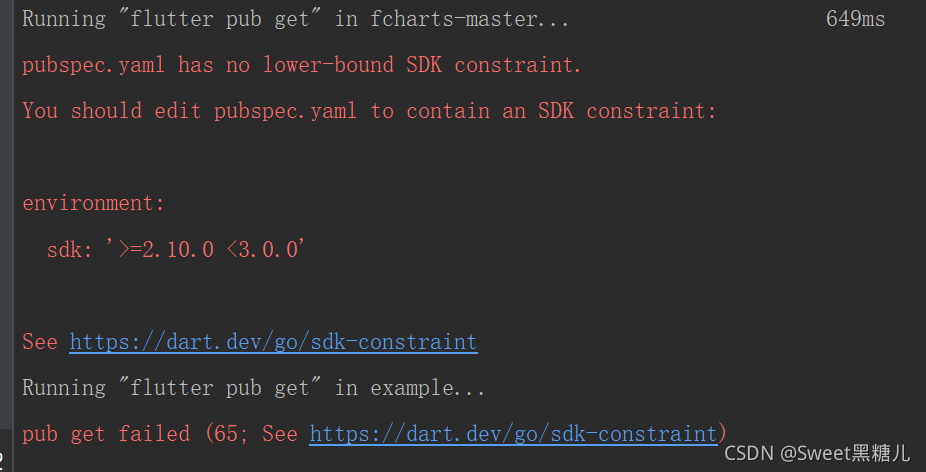
add to pubspec.yaml:
environment: SDK:’ >= 2.10.0 < 3.0.0 ‘
after rerunning fluent pub get, an error is still reported, indicating that the SDK constraint is not added. Later, it is found that the subfolder example of the home folder also contains a pubspec.yaml file, in which the SDK constraint is not added
after adding constraints, run fluent pub get.
Error reporting using NVIDIA SMI:
NVIDIA-SMI has failed because it couldn’t communicate with the NVIDIA driver. Make sure that the latest NVIDIA driver is installed and running
This is a common problem, which often occurs in Ubuntu systems. The main reason is that the system kernel has been upgraded, resulting in the mismatch between the new kernel and the original graphics card driver
Solution 1:
Just execute two commands:
Sudo apt get install DKMS
sudo DKMS install – M NVIDIA – V 440.44 (440.44 indicates the driver version number)
Use the command ll/usr/SRC/to view the nvidia-440.44/ folder below. The version number varies from computer to computer
Details of error reporting are as follows
root@OpenWrt :~# /root/connect_ net.sh
-ash: /root/connect_ net.sh: not found
When running a script, the above error occurs. The variables in the script are defined as
code = curl - O/dev/null - SW% {http_code} www.baidu. Com
After querying, it is found that the shell only supports ash in openwrt, while Bash is used by default in Linux and Ubuntu
The solution here is when defining variables, the left and right sides of the equal sign '=' are not left blank, as shown in the example
code = curl - O/dev/null - SW% {http_code} www.baidu. Com
The operation of variables in openwrt still needs attention
Running gulp reports an error

you need to use version 8.0 or below, and gulp imagemin updated version 8.0 the previous month…
solution: delete the previously installed gulp imagemin and download the lower version NPM install -- save dev gulp- [email protected]
JMeter operation error
Response code: non HTTP response code: java.lang.illegalargumentexception
response message: non HTTP response message: bound must be greater than origin
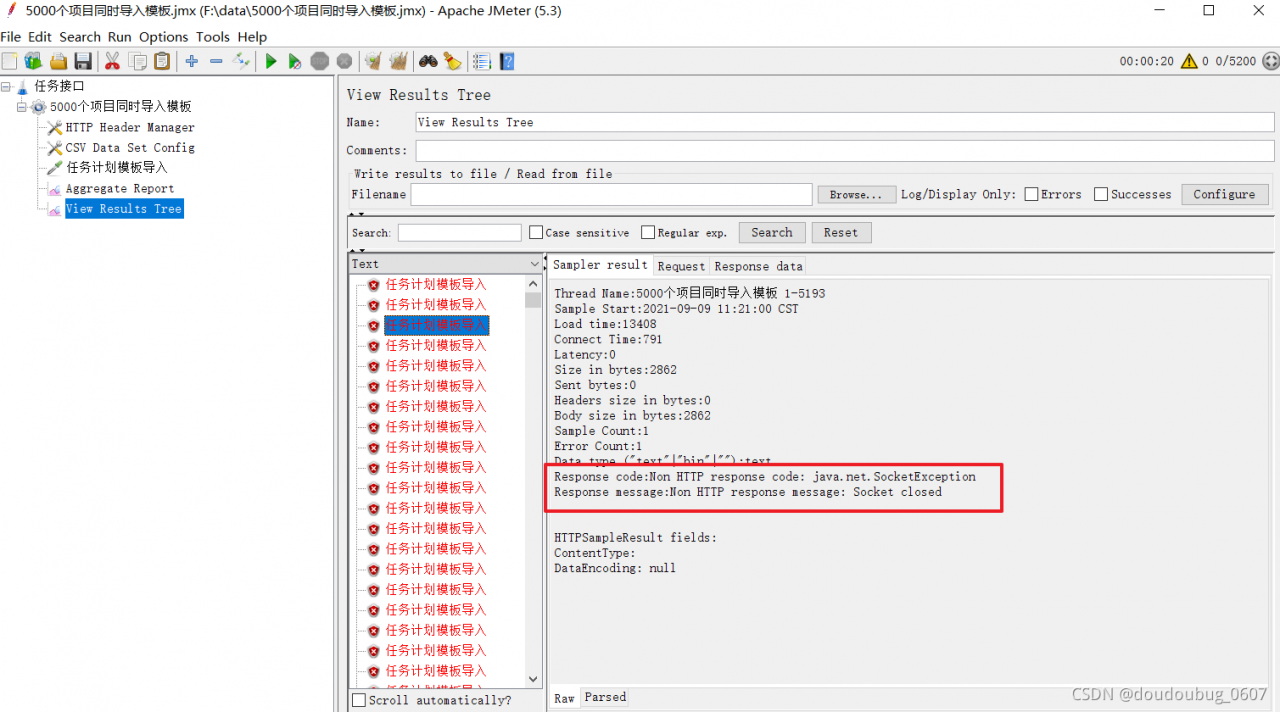
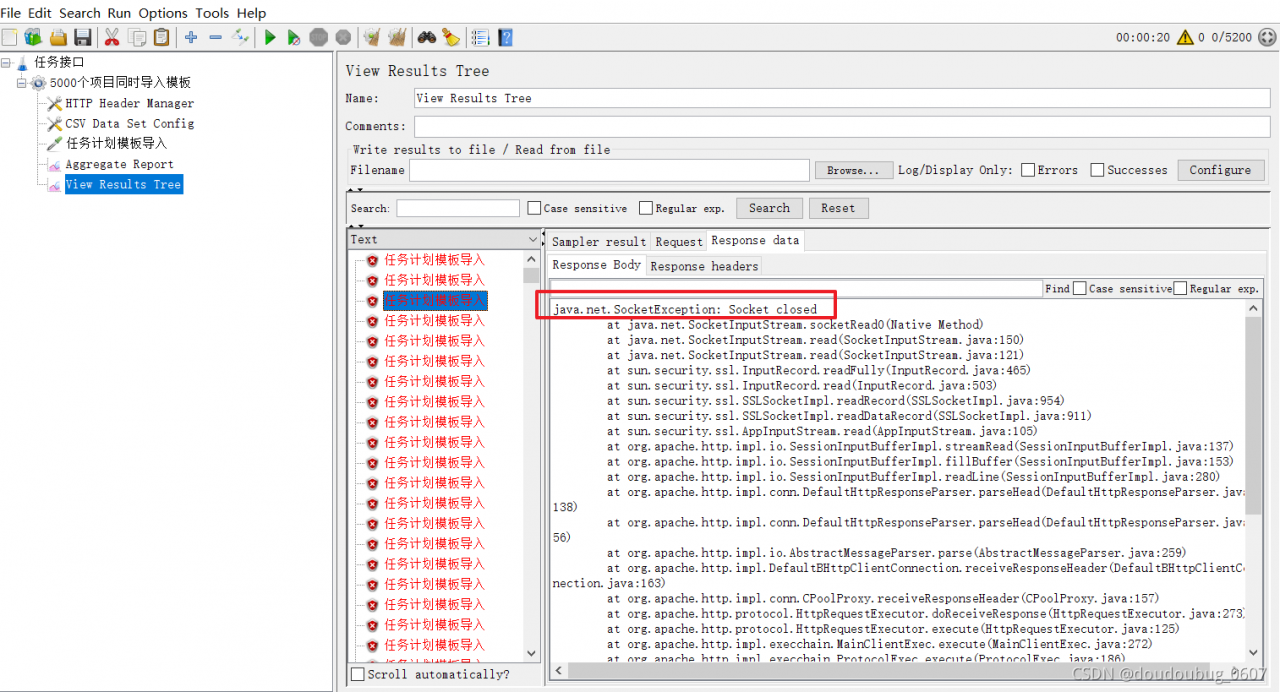
the error is due to the problem of parameter transmission. First, we need to check whether the parameter is correct
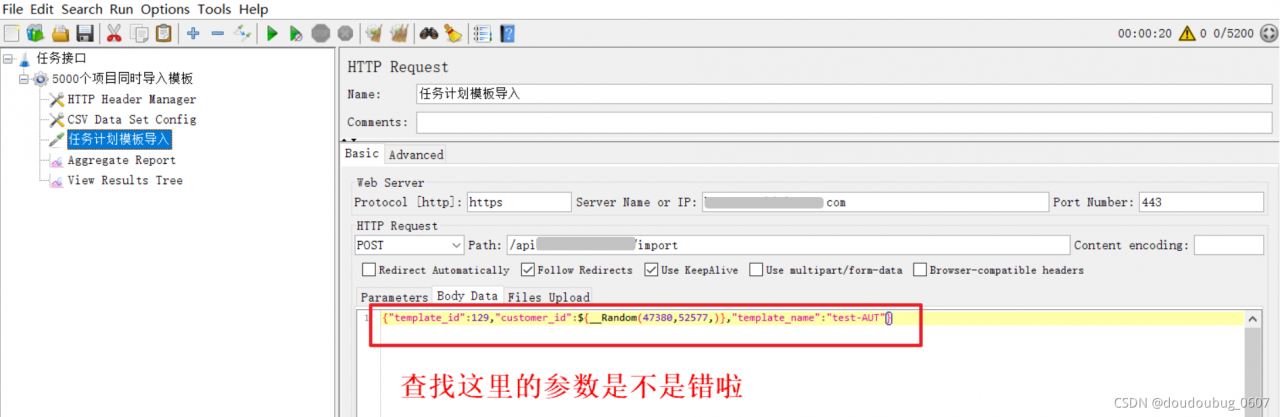
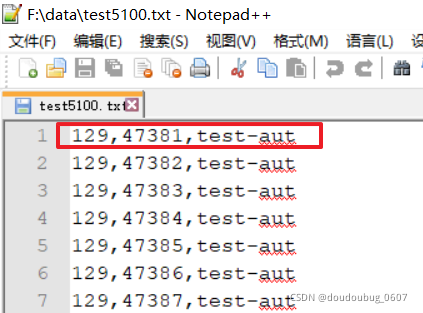
after checking, we find that the name is wrong, The case is not distinguished, so it can’t be found all the time. It’s successful to run after modification.
Resolve runtime error: CUDA error: cublas_STATUS_EXECUTION_FAILED when calling `cubla…
The running experiment encountered this problem. At the beginning, it was found that some people said it was because the dimensions might be different, but after inspection, this problem did not exist.
Another solution is to add a sentence of code
torch.backends.cudnn.enabled = false , but I haven’t tried yet, because it is found that the CUDA device settings of the main.py file and other files are different (there is not much data, I didn’t set nn.dataparallel, so there will be no problem after the changes are consistent.
Therefore, if you encounter this problem, you can check whether each variable and model are on the same CUDA device.