Category Archives: How to Fix

Spring initializer error: initialization failed for ‘ https://start.spring.io ‘

Error message

Initialization failed for 'https://start.spring.io'

The solution
There are two
The first kind of
Change HTTPS to HTTP in https://start.spring.io/
The second,
-> Open Settings interface
- & gt; pearance & >
code> -> Click HTTP Proxy menu
- & gt; Check Auto - detect the proxy Settings check box
- & gt; Check Automatic proxy configuration URL: check box, and enter https://start.spring.io/
in the input box - & gt; e> exit

Module build failed: TypeError [ERR_INVALID_ARG_TYPE]: The “path“ argument must be of type string.

The following error was reported for the VUE project

Module build failed: TypeError [ERR_INVALID_ARG_TYPE]: The "path" argument must be of type string. Received undefined
    at validateString (internal/validators.js:121:11)
    at Object.join (path.js:375:7)
    at getSassOptions (D:\VueProj\test\node_modules\sass-loader\dist\utils.js:160:37)
    at Object.loader (D:\VueProj\test\node_modules\sass-loader\dist\index.js:36:49)

sass-loader version is too high cause, reinstall the lower version of sass-loader.

npm uninstall sass-loader
npm install --save-dev [email protected]

After introducing sass into Vue project, start to report error typeerror [err]_ INVALID_ ARG_ Type]: the “path” argument must be of type string

 
Vue file using lang=” SCSS “,
The solution: be sure to install sass-loader and node-sass
TypeError [ERR_INVALID_ARG_TYPE]: The “path” argument must be of type string.
 
Json: “node-sass”: “^4.11.1”, “sass-loader”: “^7.3.0
Delete the node_modules folder and re-execute NPM install. Perfect solution

appear org.springframework.beans . factory.BeanCreationException Causes and solutions of abnormal

1 Abnormal description
After checking out the project from SVN and configuring it, start the Tomcat server and report the following error:

2 Abnormal Causes
By observing the abnormal information marked in the figure above, we can know

Org. Springframework. Beans. Factory. BeanCreationException: Error creating bean with the name ‘XXX’

This exception is: Injection bean failed exception.
To put it bluntly, if this exception occurs, the corresponding bean cannot be found! The reasons why bean injection can fail include but are not limited to the following:
The corresponding bean is not annotated; @service stead of dubbo; Select the wrong automatic injection method, etc.
3 Solutions
Now that we know the cause of this exception, we look back at the corresponding Bean declaration and see that the code that injected the Facade is:

@Autowired
ErrorCodeFacade errorCodeFacade;

Well, here’s the mistake! In general, when injecting interfaces at the Service and Biz layer, you can use @Autowiredfor example:

@Autowired
ErrorCodeService errorCodeService;

But, when injected into the Facade layer interface, should use the RemoteServiceFactory. GetService () , such as:

ErrorCodeFacade errorCodeFacade = RemoteServiceFactory.getService(ErrorCodeFacade.class);

That is, the exception is resolved by declaring the ErrorCodeFacade with the code above.


Warm prompt: there are many reasons for this exception, the above only lists the problems I encountered and solutions, I hope to be helpful to you!
Version 1.8.0_201 of the JVM is not suitable for this product. Version: 11 or greater is required.

Eclipse starts with this problem:
Version 1.8.0_201 of the JVM is not suitable for this product. Version: 11 or greater is required.
 
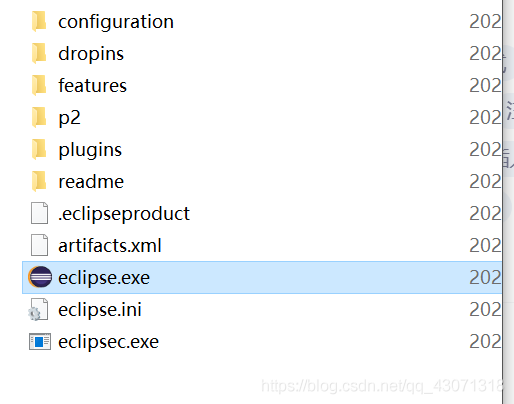
Solution: Open Eclipse.ini and modify it as follows


-Xmx1024m
-startup
plugins/org.eclipse.equinox.launcher_1.5.800.v20200727-1323.jar
--launcher.library
plugins/org.eclipse.equinox.launcher.win32.win32.x86_64_1.1.1300.v20200819-0940
-product
org.eclipse.epp.package.java.product
-showsplash
org.eclipse.epp.package.common
--launcher.defaultAction
openFile
--launcher.defaultAction
openFile
--launcher.appendVmargs
-vmargs
-Dosgi.requiredJavaVersion=1.8
[email protected]/eclipse-workspace
-XX:+UseG1GC
-XX:+UseStringDeduplication
--add-modules=ALL-SYSTEM
-Dosgi.requiredJavaVersion=1.8
-Dosgi.dataAreaRequiresExplicitInit=true
-Xms256m
-Xmx2048m
--add-modules=ALL-SYSTEM
-vm
-D:\java\jdk\bin\javaw.exe

Add JDK path:
-vm
-D:\java\jdk\bin\javaw.exe
The modified version is 1.8

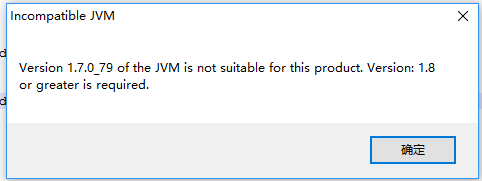
Start eclipse and prompt version 1.7.0_ 79 of the JVM is not suitable for this product. Version: 1.8 or greater i…

When you start Eclipse, the following pop-up box pops up:

Solutions:
Find the eclipse.ini file in the Eclipse installation directory and go to the
– vmargs.
– Dosgi requiredJavaVersion = 1.8
prefix
– vm
D:/Program Files/Java/jdk1.8.0 _111/jre/bin/server/JVM. DLL
Note: -vm is to be added before -vmargs
– vm
D:/Program Files/Java/jdk1.8.0 _111/jre/bin/server/JVM. DLL should pay attention to the direction of the slash, if written
– vm
D: \ \ Program Files \ Java \ jdk1.8.0 _111 \ jre \ bin \ server \ JVM DLL
Eclipse will exit automatically after starting Eclipse
There is another option: uninstall JDK 1.7 and install JDK 1.8
 

Reproduced in: https://www.cnblogs.com/nana-blog/p/10385723.html

How to solve the problem of “version 11 or greater is required” in eclipse 2020

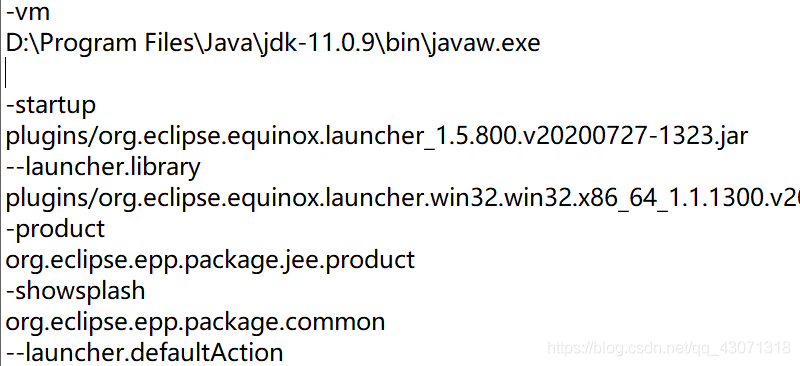
After I installed Eclipse 2020, I opened it directly and said “Version 11 or greater is required”, so I installed JDK11 following its instructions, but I still reported the same error after I installed Eclipse 2020. After searching on the Internet, I found that this should be the solution:
Find the eclipse in the file directory. The ini file:

at the beginning of the ini file to add this two lines:

the first line – vm, the second line of the JDK package javaw. Exe open path. Save it and you’ll be able to open Eclipse 2020 normally.

Where’s Maven pom.xml Configure aliyun warehouse in

<repositories>
        <repository>
            <id>nexus-aliyun</id>
            <name>Nexus aliyun</name>
            <url>https://maven.aliyun.com/repository/public</url>
            <layout>default</layout>
            <snapshots>
                <enabled>false</enabled>
            </snapshots>
            <releases>
                <enabled>true</enabled>
            </releases>
        </repository>
    </repositories>
    <pluginRepositories>
        <pluginRepository>
            <id>nexus-aliyun</id>
            <name>Nexus aliyun</name>
            <url>https://maven.aliyun.com/repository/public</url>
            <snapshots>
                <enabled>false</enabled>
            </snapshots>
            <releases>
                <enabled>true</enabled>
            </releases>
        </pluginRepository>
    </pluginRepositories>


Expected indentation of 6 spaces but found 10

Expected indentation of 6 Spaces but found
10 The code is automatically formatted according to IDEA’s reformat
de, and the result is that the error is reported more and more. When Vue projects are initialized, ESLint is installed by default (ESLint is a syntax-rule and style-checking tool that can be used to ensure that syntax-correct, style-consistent code is written).

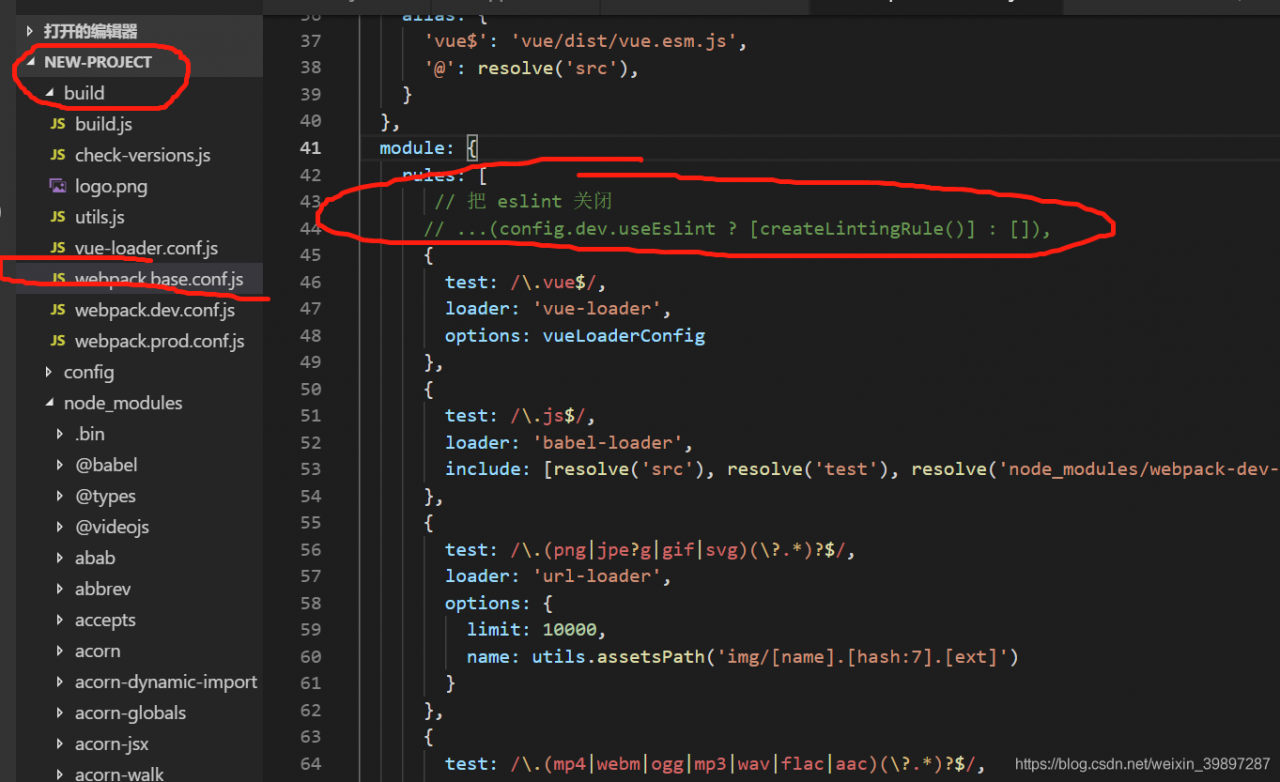
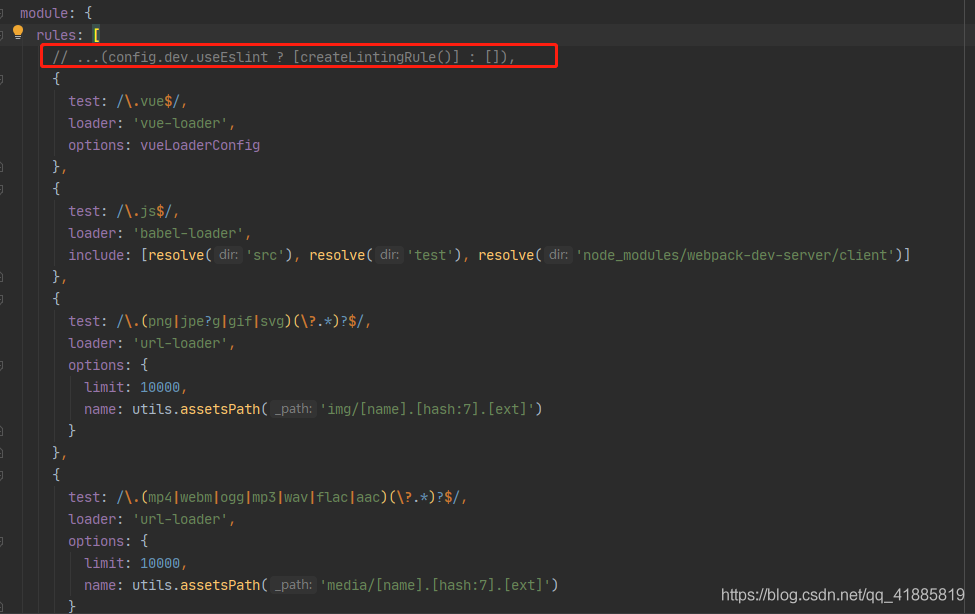
The solution here is to turn ESLint off, as follows.
Open the project’s…/build/webpack. Base. Conf. Js file, find the module properties, comment out the following this line of code.