MessageColumnIO.MessageColumnIORecordConsumer .startMessage; ParquetWriteSupport.writeFields : write the value of each column in a row, except null value; MessageColumnIO.MessageColumnIORecordConsumer . endmessage: write null value for missing fields in the second step.
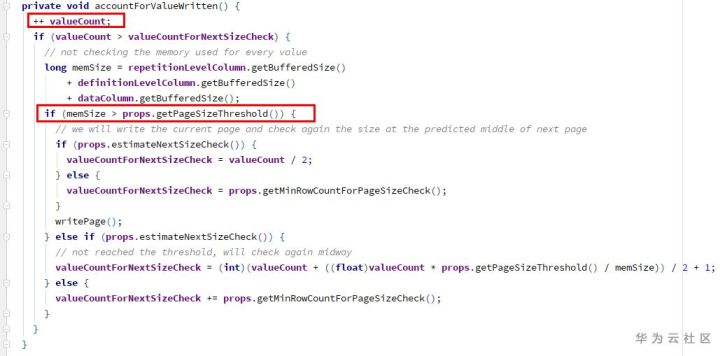
Columnwriterv1. Writenull – & gt; accountforvaluewritten:
1) increase the counter valuecount (int type)
2) to check whether the space is full, writepage – checkpoint 1 is required
(2) Increase counter RecordCount (long type)
(3) Check the block size to see if flushrowgrouptostore – checkpoint 2 is required
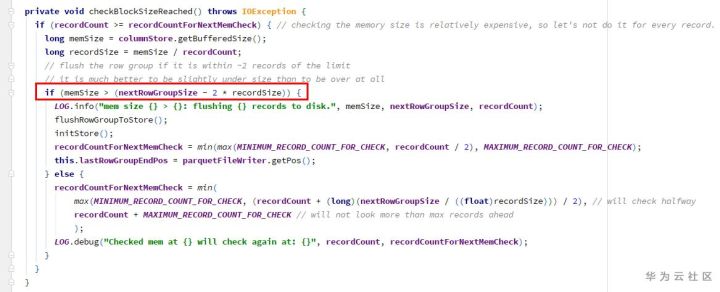
Since all the written values are null and the memsize of 1 and 2 checkpoints is 0, page and row group will not be refreshed. As a result, null values are always added to the same page. The counter valuecount of columnwriterv1 is of type int, when it exceeds int.max The overflow becomes a negative number.
Therefore, flushrowgrouptostore is executed only when the close() method is called (at the end of the task):
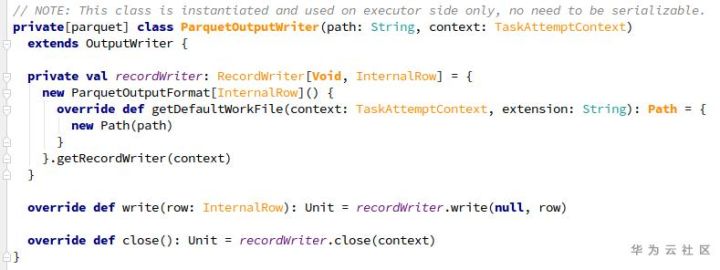
the ParquetOutputWriter.close -> ParquetRecordWriter.close
-> Interna lParquetRecordWriter.close -> flushRowGroupToStore
-> ColumnWriteStoreV1.flush -> for each column ColumnWriterV1.flush
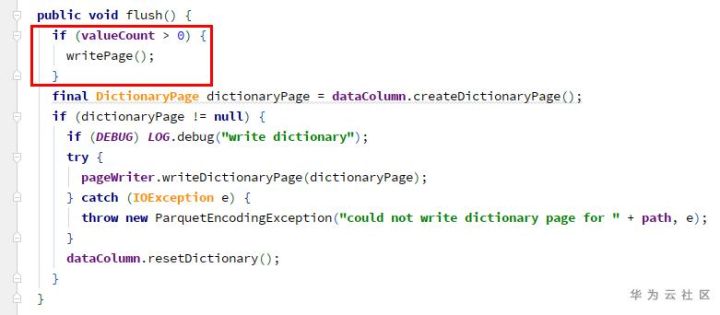
Page will not be written here because valuecount overflow is negative.
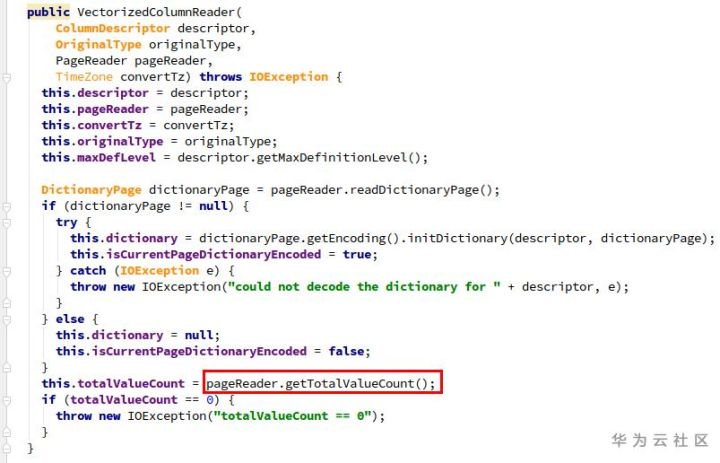
Because writepage has not been called, the totalvaluecount here is always 0.
ColumnWriterV1.writePage -> C olumnChunkPageWriter.writePage -&Value total
At the end of the write, interna lParquetRecordWriter.close -> flushRowGroupToStore -> Colum nChunkPageWriteStore.flushToFileWriter -> for each column C olumnChunkPageWriter.writeToFileWriter :
ParquetFileWriter.startColumn : totalvaluecount is assigned to currentchunkvalueco untParquetFileWriter.writeDataPagesParquetFileWriter . endcolumn: currentchunk valuecount (0) and other metadata information construct a columnchunk metadata, and the relevant information will be written to the file eventually.
3.2 read process
Also, take spark as the entry to view.
Initialization phase: ParquetFileFormat.BuildReaderWithPartitionValues -> Vectorize dParquetRecordReader.initialize -> ParquetFileReader.readFooter -> Parq uetMetadataConverter.readParquetMetadata -> fromParquetMetadata -> ColumnChunkMetaData.get , which contains valuecount (0).
When reading: vectorize dParquetRecordReader.nextBatch -> checkEndOfRowGroup:
1) ParquetFileReader.readNextRowGroup -> for each chunk, currentRowGroup.addColumn ( chunk.descriptor.col , chunk.readAllPages ())
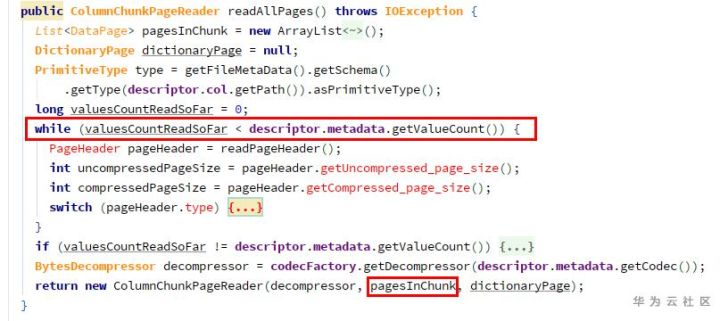
Since getvaluecount is 0, pagesinchunk is empty.
2) Construct columnchunkpagereader:
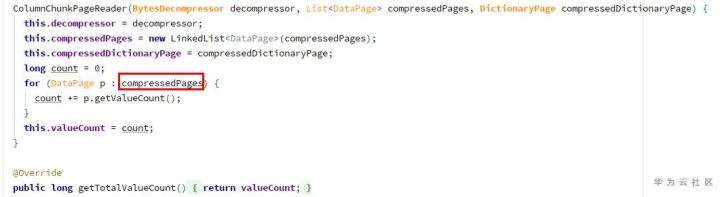
Because the page list is empty, the totalvaluecount is 0, resulting in an error in the construction of vectorizedcolumnreader.
4. Solution: parquet upgrade (version 1.11.1)
In the new version, ParquetWriteSupport.write ->
MessageColumnIO.MessageColumnIORecordConsumer .endMessage ->
ColumnWriteStoreV1(ColumnWriteStoreBase).endRecord:
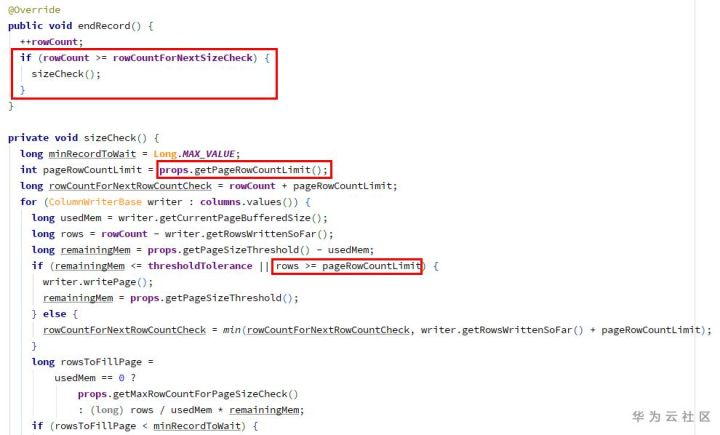
In endrecord, the attribute of maximum number of records per page (2W records by default) and the check logic are added. When the limit is exceeded, writepage will be generated, so that the valuecount of columnwriterv1 will not overflow (it will be cleared after each writepage).
Compared with the old version 1.8.3, columnwritestorev1.endrecord is empty.
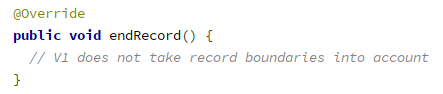
Attachment: a small trick in parquet
In parquet, in order to save space, when a long type value is within a certain range, int will be used to store it. The method is as follows:
Determine whether it can be stored with int:

If you can, use intcolumnchunkmetadata instead of longcolumnchunkmetadata to convert on construction time:

When you use it, turn it back, in tColumnChunkMetaData.getValueCount -> intToPositiveLong():

The common int range is – 2 ^ 31 ~ (2 ^ 31 – 1). Because metadata information (such as valuecount) is a non negative integer, it can only store numbers in the 0 ~ (2 ^ 31 – 1) range. In this way, the number in the range of 0 ~ (2 ^ 32 – 1) can be expressed, and the expression range is doubled.
Attachment: test case code that can be used to reproduce (depending on some spark classes, it can be run in spark project)
Test case code.txt 1.88kb
Click follow to learn about Huawei’s new cloud technology for the first time~