Warning – this build will not support IPVS with IPv6

Project scenario:

In Linux system, use the command to decompress and install the keepalived source package.


Problem Description:

To install the keepalived source code package, you have run the following command:

tar -xzvf keepalived-2.2.2.tar.gz
cd keepalived-2.2.2
./configure --prefix=/usr/local/keepalived
yum -y install gcc
./configure --prefix=/usr/local/keepalived
yum -y install openssl openssl-devel
./configure --prefix=/usr/local/keepalived

The third command run result error, solved (solution), the fifth command run result error, solved (solution), in the seventh line re run the command error, the warning message is:

*** WARNING - this build will not support IPVS with IPv6. Please install libnl/libnl-3 dev libraries to support IPv6 with IPVS.

Cause analysis:

The main reason for this error is the lack of libnl core library. Just install libnl and libnl devel.


Solution:

Install libnl and libnl devel:

yum -y install libnl libnl-devel

Rerun the command ./configure -- prefix =/usr/local/kept , the command runs normally, and the problem is solved.

If there are other errors, please refer to:
configure: error: no acceptable C compiler found in $path error resolution
configure: error:!! OpenSSL is not properly installed on your system.!! Error resolution

Error opening device

Debugging QT project found an error, error opening device.
Look at the error and think it’s a hardware problem. Look for this character.

It must have loaded the dynamic library, and the error was printed in the dynamic library.
Deubg step by step found that it was qjson parsing error, Nari???
What is the relationship between qjson parsing and opening device errors?

Then use:

ll@ubuntu:~/QJson/lib$ strings libqjson.so | grep opening

It is found that there is this:
error opening device

Finally, look at the GitHub source code:
https://github.com/flavio/qjson/blob/master/src/parser.cpp

QVariant Parser::parse(QIODevice* io, bool* ok)
{
  d->reset();

  if (!io->isOpen()) {
    if (!io->open(QIODevice::ReadOnly)) {
      if (ok != 0)
        *ok = false;
      qCritical ("Error opening device");
      return QVariant();
    }
  }
  ......
}
 

I think it should be changed to error opening file.
all is file!
That’s all.

Error from Python installation Library: Microsoft Visual C + + 14.0 is required

Error: Microsoft Visual C + + 14.0 is required. Get it with Microsoft Visual C + +

Error: Microsoft Visual C + + 14.0 is required. Get it with “build tools for visual studio”: https://visualstudio.microsoft.com/downloads/

Finally, a Microsoft Visual C + + build tools 2015
is found https://go.microsoft.com/fwlink/?LinkId=691126
The file name is: visual cppbuildtools full, download and install.

Double click visual cppbuilder tools_ full.exe , select the default, click Install, and wait about 10 minutes to complete the installation.
Then install the PIP library.

Calling Dubbo Service reported the following error (com.alibaba.dubbo.remoting.RemotingException) Causes and Solutions

2017-04-19 23:41:48,333 ERROR [com.alibaba.dubbo.remoting.transport.AbstractClient] –  [DUBBO] Failed to start NettyClient LX-20161101CZVB/169.254.129.62 connect to the server /127.0.0.1:20882 (check == false, ignore and retry later!), cause: client(url: dubbo://127.0.0.1:20882/cn.tengfei.service.product.AdService?application=sportman-console&codec=dubbo&default.check=false&default.timeout=999999&dubbo=2.5.3&heartbeat=60000&interface=cn.tengfei.service.product.AdService&methods=selectAdsJsonListByParent,insertAd,selectAdListByParentId&pid=8020&revision=0.0.1-SNAPSHOT&side=consumer&timestamp=1492616507128) failed to connect to server /127.0.0.1:20882, error message is:Connection refused: no further information, dubbo version: 2.5.3, current host: 169.254.129.62

com.alibaba.dubbo.remoting.RemotingException: client(url: dubbo://127.0.0.1:20882/cn.tengfei.service.product.AdService?application=sportman-console&codec=dubbo&default.check=false&default.timeout=999999&dubbo=2.5.3&heartbeat=60000&interface=cn.tengfei.service.product.AdService&methods=selectAdsJsonListByParent,insertAd,selectAdListByParentId&pid=8020&revision=0.0.1-SNAPSHOT&side=consumer&timestamp=1492616507128) failed to connect to server /127.0.0.1:20882, error message is:Connection refused: no further information

at com.alibaba.dubbo.remoting.transport.netty.NettyClient.doConnect(NettyClient.java:124)

at com.alibaba.dubbo.remoting.transport.AbstractClient.connect(AbstractClient.java:280)

at com.alibaba.dubbo.remoting.transport.AbstractClient.<init>(AbstractClient.java:103)

at com.alibaba.dubbo.remoting.transport.netty.NettyClient.<init>(NettyClient.java:61)

at com.alibaba.dubbo.remoting.transport.netty.NettyTransporter.connect(NettyTransporter.java:37)

at com.alibaba.dubbo.remoting.Transporter$Adpative.connect(Transporter$Adpative.java)

at com.alibaba.dubbo.remoting.Transporters.connect(Transporters.java:67)

at com.alibaba.dubbo.remoting.exchange.support.header.HeaderExchanger.connect(HeaderExchanger.java:37)

at com.alibaba.dubbo.remoting.exchange.Exchangers.connect(Exchangers.java:102)

at com.alibaba.dubbo.rpc.protocol.dubbo.DubboProtocol.initClient(DubboProtocol.java:378)

at com.alibaba.dubbo.rpc.protocol.dubbo.DubboProtocol.getSharedClient(DubboProtocol.java:344)

at com.alibaba.dubbo.rpc.protocol.dubbo.DubboProtocol.getClients(DubboProtocol.java:321)

at com.alibaba.dubbo.rpc.protocol.dubbo.DubboProtocol.refer(DubboProtocol.java:303)

at com.alibaba.dubbo.rpc.protocol.ProtocolListenerWrapper.refer(ProtocolListenerWrapper.java:65)

at com.alibaba.dubbo.rpc.protocol.ProtocolFilterWrapper.refer(ProtocolFilterWrapper.java:62)

at com.alibaba.dubbo.rpc.Protocol$Adpative.refer(Protocol$Adpative.java)

at com.alibaba.dubbo.config.ReferenceConfig.createProxy(ReferenceConfig.java:392)

at com.alibaba.dubbo.config.ReferenceConfig.init(ReferenceConfig.java:300)

at com.alibaba.dubbo.config.ReferenceConfig.get(ReferenceConfig.java:138)

at com.alibaba.dubbo.config.spring.ReferenceBean.getObject(ReferenceBean.java:65)

at org.springframework.beans.factory.support.FactoryBeanRegistrySupport.doGetObjectFromFactoryBean(FactoryBeanRegistrySupport.java:168)

at org.springframework.beans.factory.support.FactoryBeanRegistrySupport.getObjectFromFactoryBean(FactoryBeanRegistrySupport.java:103)

at org.springframework.beans.factory.support.AbstractBeanFactory.getObjectForBeanInstance(AbstractBeanFactory.java:1506)

at org.springframework.beans.factory.support.AbstractBeanFactory.doGetBean(AbstractBeanFactory.java:250)

at org.springframework.beans.factory.support.AbstractBeanFactory.getBean(AbstractBeanFactory.java:193)

at org.springframework.beans.factory.support.DefaultListableBeanFactory.findAutowireCandidates(DefaultListableBeanFactory.java:1127)

at org.springframework.beans.factory.support.DefaultListableBeanFactory.doResolveDependency(DefaultListableBeanFactory.java:1051)

at org.springframework.beans.factory.support.DefaultListableBeanFactory.resolveDependency(DefaultListableBeanFactory.java:949)

at org.springframework.beans.factory.annotation.AutowiredAnnotationBeanPostProcessor$AutowiredFieldElement.inject(AutowiredAnnotationBeanPostProcessor.java:530)

at org.springframework.beans.factory.annotation.InjectionMetadata.inject(InjectionMetadata.java:87)

at org.springframework.beans.factory.annotation.AutowiredAnnotationBeanPostProcessor.postProcessPropertyValues(AutowiredAnnotationBeanPostProcessor.java:331)

at org.springframework.beans.factory.support.AbstractAutowireCapableBeanFactory.populateBean(AbstractAutowireCapableBeanFactory.java:1202)

at org.springframework.beans.factory.support.AbstractAutowireCapableBeanFactory.doCreateBean(AbstractAutowireCapableBeanFactory.java:537)

at org.springframework.beans.factory.support.AbstractAutowireCapableBeanFactory.createBean(AbstractAutowireCapableBeanFactory.java:476)

at org.springframework.beans.factory.support.AbstractBeanFactory$1.getObject(AbstractBeanFactory.java:302)

at org.springframework.beans.factory.support.DefaultSingletonBeanRegistry.getSingleton(DefaultSingletonBeanRegistry.java:230)

at org.springframework.beans.factory.support.AbstractBeanFactory.doGetBean(AbstractBeanFactory.java:298)

at org.springframework.beans.factory.support.AbstractBeanFactory.getBean(AbstractBeanFactory.java:193)

at org.springframework.beans.factory.support.DefaultListableBeanFactory.preInstantiateSingletons(DefaultListableBeanFactory.java:762)

at org.springframework.context.support.AbstractApplicationContext.finishBeanFactoryInitialization(AbstractApplicationContext.java:757)

at org.springframework.context.support.AbstractApplicationContext.refresh(AbstractApplicationContext.java:480)

at org.springframework.web.servlet.FrameworkServlet.configureAndRefreshWebApplicationContext(FrameworkServlet.java:663)

at org.springframework.web.servlet.FrameworkServlet.createWebApplicationContext(FrameworkServlet.java:629)

at org.springframework.web.servlet.FrameworkServlet.createWebApplicationContext(FrameworkServlet.java:677)

at org.springframework.web.servlet.FrameworkServlet.initWebApplicationContext(FrameworkServlet.java:548)

It’s very clear that if the connection fails, you need to find the configuration file of the connection or other related files. My reason is that the zookeeper in Dubbo’s registry is configured in Linux, but I haven’t started Linux, and the zookeeper certainly hasn’t started, so the connection fails


How to Solve ERROR – unregister mbean error javax.management.InstanceNotFoundException: com.alibaba.druid:type=

In the project, Druid is used to manage the database connection pool. There is no problem in the local and test environment. However, after the production environment, when Tomcat is started for the first time, the log does not report an error, but the page can’t come out. When Tomcat is closed, you can see the log and find that the error is as follows:

ERROR [ com.alibaba.druid . stat.DruidDataSourceStatManager ] – unregister mbean error
javax.management.InstanceNotFoundException : com.alibaba.druid :type=DruidDataSourceStat
at com.sun.jmx . interceptor.DefaultMBeanServerInterceptor .getMBean………


Various methods have been found on the Internet, but they are all vague. After many tests, the solution is as follows:

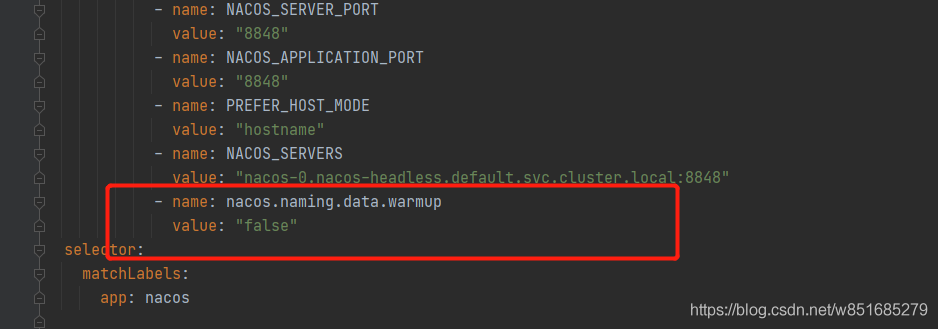
Modify the bin directory of Tomcat catalina.sh File in OS specific support. $var_ must_ Be set to either true or false

JAVA_ OPTS=”- Ddruid.registerToSysProperty=true “OK, as shown in the figure:

After tomcat, just start the deployment project once and don’t report this error again.

How to Solve Error executing DDL in JPA

Error report in automatic meter building

Spring boot configuration file to configure such a section

#jpa Configuration
jpa:
  #console display sql statements
  show-sql: true
  database: mysql
  hibernate:
    ddl-auto: update
  open-in-view: true
  #error: Error executing DDL
  database-platform: org.hibernate.dialect.MySQL5InnoDBDialect

[robot_launch.launch] is neither a launch file in package [kinova_gazebo] nor is

Problem Description:

[robot_launch.launch] is neither a launch file in package [kinova_gazebo] nor is [kinova_gazebo] a launch file name
The traceback for the exception was written to the log file

terms of settlement:

The error indicates that the corresponding package is not installed in the ROS system. In this case, go to the top of the project file and use catkin_ The make command compiles the file. If it is executed again at this time, an error will still be reported. Then add another statement:

source devel/setup.bash

Will devel/ setup.bash Add to the system, and then run

Common errors in k8s initialization_ [WARNING NumCPU]_ [WARNING SystemVerification]_ WARNING Hostname

Common errors in k8s initialization

[init] Using Kubernetes version: v1.20.5
[preflight] Running pre-flight checks
    1    [WARNING NumCPU]: the number of available CPUs 1 is less than the required 2
    2    [WARNING IsDockerSystemdCheck]: detected "cgroupfs" as the Docker cgroup driver. The recommended driver is "systemd". Please follow the guide at https://kubernetes.io/docs/setup/cri/
    3    [WARNING SystemVerification]: this Docker version is not on the list of validated versions: 20.10.5. Latest validated version: 19.03
    4    [WARNING Hostname]: hostname "k8s" could not be reached
    5    [WARNING Hostname]: hostname "k8s": lookup k8s on 192.168.0.1:53: no such host

Solution:
1. Adjust the number of CPU cores to the current number of cores + 1 (self adaptation)
2. Change the settings to make the container runtime and kubelet use SYSTEMd as CGroup driver https://blog.whsir.com/post-5312.html
3. Re install docker, and the latest verification version of docker is 19.03
4. Configure domain name resolution/etc/hosts
5. Refer to 4

Batch error reporting in Java spring

1、 Questions

Error in starting batch task:

ERROR [com.alibaba.druid.pool.DruidDataSource]
 - {dataSource-1} init error java.sql.SQLException: oracle.jdbc.OracleDriver

2、 Solution

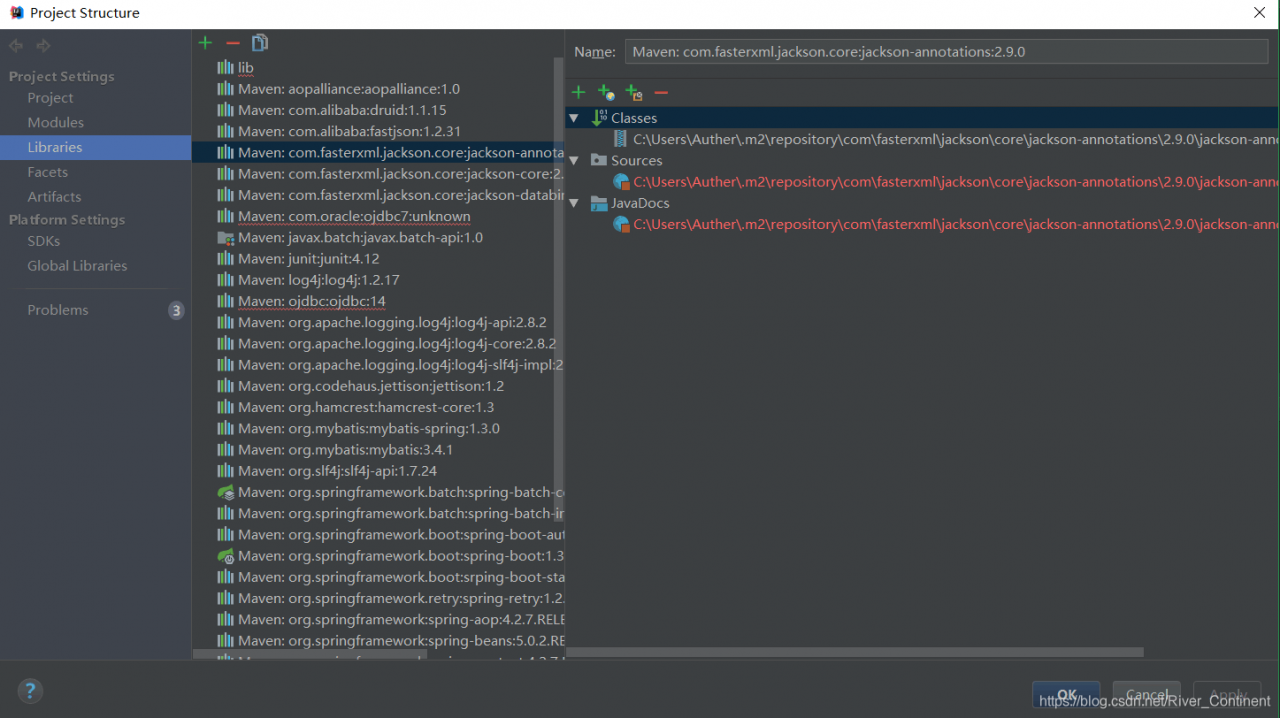
1. The reason is that I don’t have the jar package driven by JDBC, so I found a few on the Internet and asked me to download Ojdbc14 or ojdbc7. 14 is finished, but it’s useless. Ojdbc7 is the wrong version. Later, I opened the library and found that there are problems with both downloads;

You can only delete these invalid jar packages, and then find a JDBC 6 jar package to put on. The result is OK;

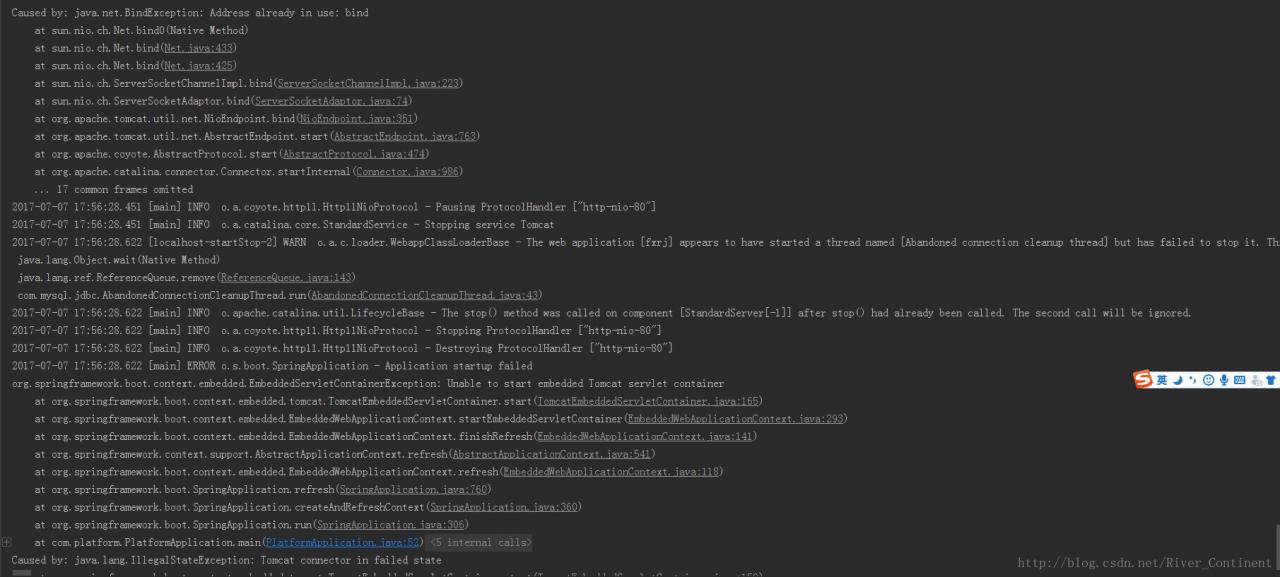
[exception] address already in use: bind

1. Problems:

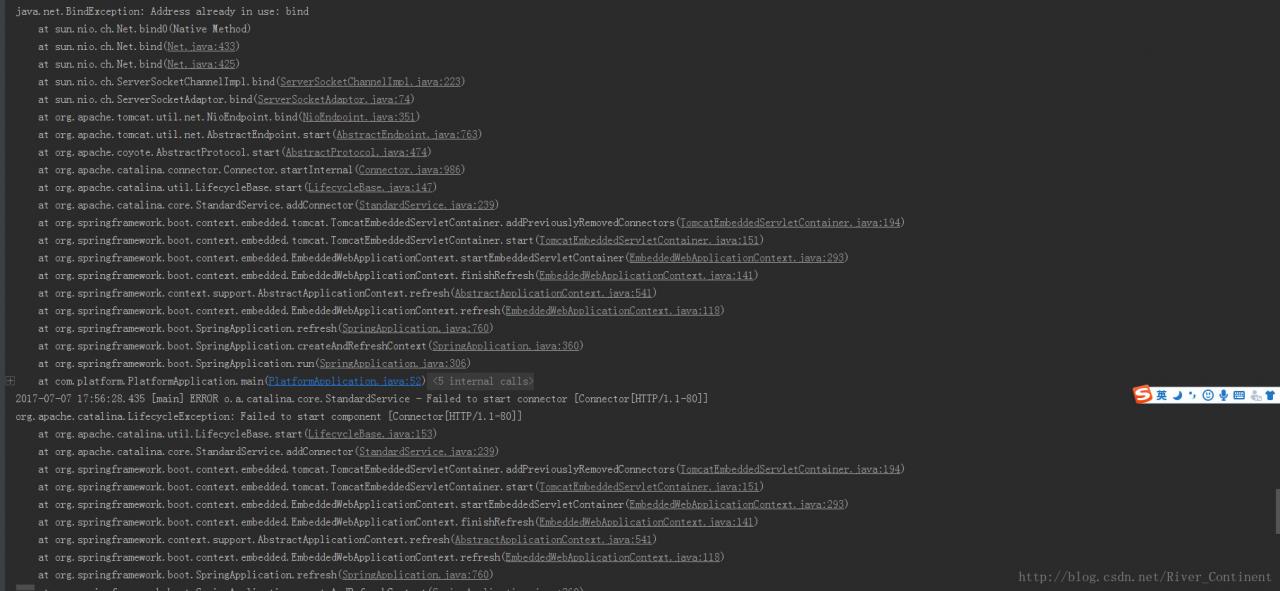
Bind Exception:Address Already in use;
Failed to start connector;
Address Already in use:bind;
EmbeddedServletContainer Excepiton:Unable to start embedder Tomcat servlet container;
IllegalState Exception:Tomcat connector in failed state;

2. Source code:

None;

3. Screenshot:

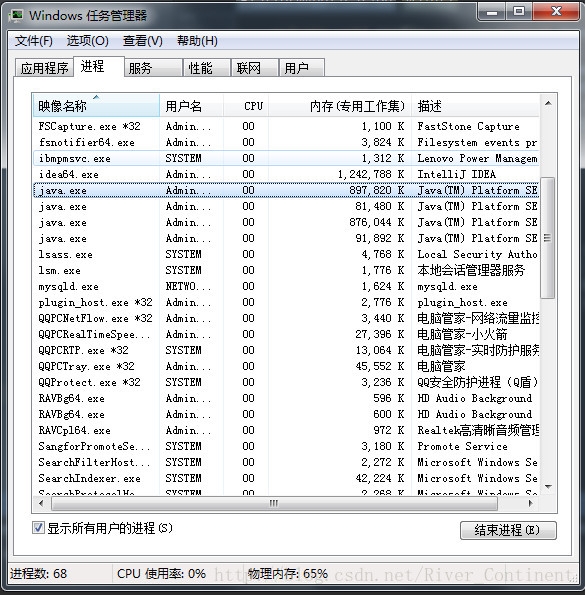
4. Summary:

Here we put it java.exe Turn it all off;