The solution is implemented at the terminal
python -m ensurepipThe results are shown in the figure

Then execute
python -m pip install --upgrade pipThe results are shown in the figure
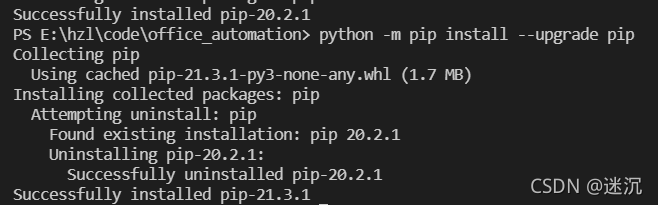
Then PIP can be used normally
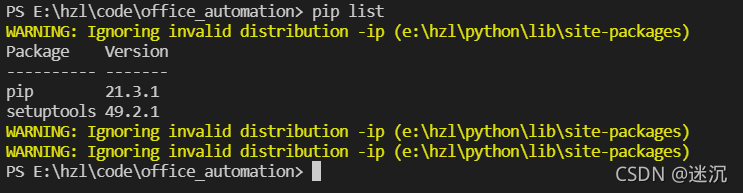
The solution is implemented at the terminal
python -m ensurepipThe results are shown in the figure
Then execute
python -m pip install --upgrade pipThe results are shown in the figure
Then PIP can be used normally
When initializing the webpack project with Vue cli, use the following commands:
$ vue init webpack [project-name]After setting up the agent of NPM and modifying the domestic image warehouse, an error is still reported. The error information is as follows:
$ vue-cli · Failed to download repo vuejs-templates/webpack: unable to verify the first certificate
According to the information, the reason for this problem is that we use the proxy server, so Vue cli cannot verify the proxy server certificate when downloading the webpack template, so this error is reported
to solve this error, one way is to turn off the verification of SSL certificates. However, this method is not valid for everyone, and the following method is only used when your proxy server is trusted:
$ npm config set npm_config_strict_ssl=false
If this method doesn’t work, another way is to use the offline method to initialize the Vue project.
Clone the webpack template project to the local C:\users [username]. Vue Templates folder. If there is no such folder, create one. The folder starting with. Cannot be created in windows. You can use CMD or PowerShell to switch to the C:\users [username]\directory and enter the following command to create the folder:
$ mkdir .vue-templatesThe download address of the webpack template is: vuejs templates. Select the required template to clone. I select the complete webpack template here. You can clone the project to the folder we created in the previous step through the following command (provided that git Bash is installed):
$ git clone https://github.com/vuejs-templates/webpack ~/.vue-templates/webpack
$ vue init webpack [project-name] --offline
$ cd [prject-name]
$ npm run devf:\py\verification.py:148: GuessedAtParserWarning: No parser was explicitly specified, so I'm using the best available HTML parser for this system ("lxml"). This usually isn't a problem, but if you run this code on another system, or in a different virtual environment, it may use a different parser and behave differently.
The code that caused this warning is on line 148 of the file f:\py\verification.py. To get rid of this
warning, pass the additional argument 'features="lxml"' to the BeautifulSoup constructor.It can operate normally, but an error message is prompted on the output console
soup = BeautifulSoup(response, ‘html’)
add: Features = "lxml" is fine
soup = BeautifulSoup(response, features="lxml")Caused by: com.mysql.cj.exceptions.InvalidConnectionAttributeException Error Messages:
Caused by: com.mysql.cj.exceptions.InvalidConnectionAttributeException: The server time zone value 'Öйú±ê׼ʱ¼ä' is unrecognized or represents more than one time zone. You must configure either the server or JDBC driver (via the serverTimezone configuration property) to use a more specifc time zone value if you want to utilize time zone support.
	at sun.reflect.GeneratedConstructorAccessor28.newInstance(Unknown Source) ~[na:na]
	at sun.reflect.DelegatingConstructorAccessorImpl.newInstance(DelegatingConstructorAccessorImpl.java:45) ~[na:1.8.0_144]
	at java.lang.reflect.Constructor.newInstance(Constructor.java:423) ~[na:1.8.0_144]
	at com.mysql.cj.exceptions.ExceptionFactory.createException(ExceptionFactory.java:61) ~[mysql-connector-java-8.0.13.jar:8.0.13]
	at com.mysql.cj.exceptions.ExceptionFactory.createException(ExceptionFactory.java:85) ~[mysql-connector-java-8.0.13.jar:8.0.13]
	at com.mysql.cj.util.TimeUtil.getCanonicalTimezone(TimeUtil.java:132) ~[mysql-connector-java-8.0.13.jar:8.0.13]
	at com.mysql.cj.protocol.a.NativeProtocol.configureTimezone(NativeProtocol.java:2234) ~[mysql-connector-java-8.0.13.jar:8.0.13]
	at com.mysql.cj.protocol.a.NativeProtocol.initServerSession(NativeProtocol.java:2258) ~[mysql-connector-java-8.0.13.jar:8.0.13]
	at com.mysql.cj.jdbc.ConnectionImpl.initializePropsFromServer(ConnectionImpl.java:1319) ~[mysql-connector-java-8.0.13.jar:8.0.13]
	at com.mysql.cj.jdbc.ConnectionImpl.connectOneTryOnly(ConnectionImpl.java:966) ~[mysql-connector-java-8.0.13.jar:8.0.13]
	at com.mysql.cj.jdbc.ConnectionImpl.createNewIO(ConnectionImpl.java:825) ~[mysql-connector-java-8.0.13.jar:8.0.13]
	... 9 common frames omitted
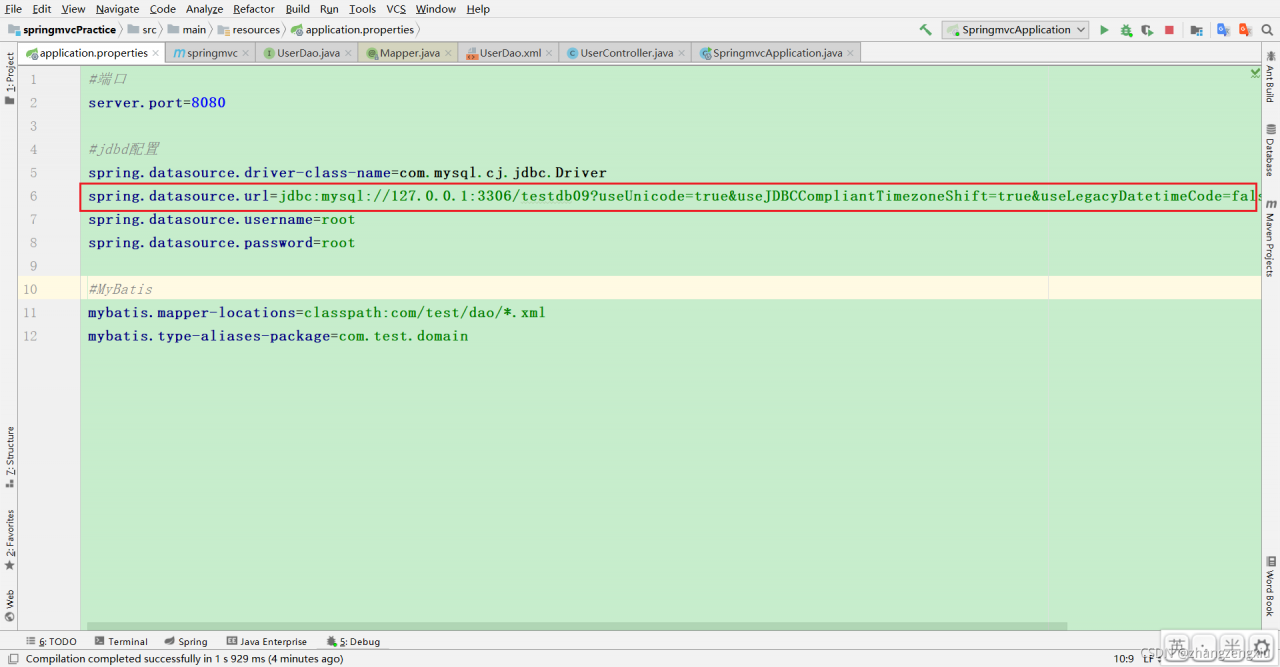
In fact, this error message is to use version 5.1.33 of MySQL JDBC Driver with UTC time zone. Servertimezone must be explicitly specified in the connection string.
Properties configuration file before modification:
server.port=8080

#jdbc
spring.datasource.driver-class-name=com.mysql.cj.jdbc.Driver
spring.datasource.url=jdbc:mysql://127.0.0.1:3306/testdb09
spring.datasource.username=root
spring.datasource.password=root

#MyBatis
mybatis.mapper-locations=classpath:com/test/dao/*.xml
mybatis.type-aliases-package=com.test.domain
After modification
server.port=8080

#jdbc
spring.datasource.driver-class-name=com.mysql.cj.jdbc.Driver
spring.datasource.url=jdbc:mysql://127.0.0.1:3306/testdb09?useUnicode=true&useJDBCCompliantTimezoneShift=true&useLegacyDatetimeCode=false&serverTimezone=UTC
spring.datasource.username=root
spring.datasource.password=root

#MyBatis
mybatis.mapper-locations=classpath:com/test/dao/*.xml
mybatis.type-aliases-package=com.test.domain
Modify:
Specific reports are as follows:
Starting MySQL
. Error! The server quit without updating PID file (/opt/homebrew/was/mysql/QdeMacBook-Pro.local.pid).
Resolution programme:
linux:
sudo chmod -R 777 /usr/local/var/mysql/
Start:
systemctl restart mysqld
Mac: homebrew installed.
chmod -R 777 /opt/homebrew/was/mysql
Start:
sudo mysql.server restart
Error! MySQL server PID file could not be found!
Starting MySQL
SUCCESS!
Problem description
This error occurs when I use the opencv3.4.16 official so file in Android studio
Sort by Pvalue from smallest to largest
Change the build.gradle file
Change arguments “- dandroid_stl = C + + _shared”
to arguments “- dandroid_stl = gnustl_shared”
Possible causes:
Opencv3.4.16 officially uses the gun compiler, so it is specified as gnustl_shared
This is because the R language default behavior is a unique identifier
Duplicate lines need to be removed
This is very common in differential expression, because different IDs may correspond to the same gene_ symbol
genes_sig <- res_sig %>%
  arrange(adj.P.Val) %>% #Sort by Pvalue from smallest to largest
  as tibble() %>%
  column_to_rownames(var = "gene_symbol")
report errors
Error in `.rowNamesDF<-`(x, value = value) :
  duplicate 'row.names' are not allowed
In addition: Warning message:
non-unique values when setting 'row.names': ‘’, ‘ AMY2A ’, ‘ ANKRD20A3 ’, ‘ ANXA8 ’, ‘ AQP12B ’, ‘ AREG ’, ‘ ARHGDIG ’, ‘ CLIC1 ’, ‘ CTRB2 ’, ‘ DPCR1 ’, ‘ FAM72B ’, ‘ FCGR3A ’, ‘ FER1L4 ’, ‘ HBA2 ’, ‘ HIST1H4I ’, ‘ HIST2H2AA4 ’, ‘ KRT17P2 ’, ‘ KRT6A ’, ‘ LOC101059935 ’, ‘ MRC1 ’, ‘ MT-TD ’, ‘ MT-TV ’, ‘ NPR3 ’, ‘ NRP2 ’, ‘ PGA3 ’, ‘ PRSS2 ’, ‘ REEP3 ’, ‘ RNU6-776P ’, ‘ SFTA2 ’, ‘ SLC44A4 ’, ‘ SNORD116-3 ’, ‘ SNORD116-5 ’, ‘ SORBS2 ’, ‘ TNXB ’, ‘ TRIM31 ’, ‘ UGT2B15 ’
Try to use the duplicated() function
res_df = res_df[!duplicated(res_df),] %>% as.tibble() %>%
column_to_rownames(var = "gene_symbol")
Still not?Duplicated removing duplicate values still shows that duplicate values exist
Error in `.rowNamesDF<-`(x, value = value) :
  duplicate 'row.names' are not allowed
In addition: Warning message:
non-unique values when setting 'row.names': ‘ AMY2A ’, ‘ ANKRD20A3 ’, ‘ ANXA8 ’, ‘ AQP12B ’, ‘ AREG ’, ‘ ARHGDIG ’, ‘ CLIC1 ’, ‘ CTRB2 ’, ‘ DPCR1 ’, ‘ FAM72B ’, ‘ FCGR3A ’, ‘ FER1L4 ’, ‘ HIST1H4I ’, ‘ HIST2H2AA4 ’, ‘ KRT17P2 ’, ‘ KRT6A ’, ‘ LOC101059935 ’, ‘ MT-TD ’, ‘ MT-TV ’, ‘ NPR3 ’, ‘ NRP2 ’, ‘ PGA3 ’, ‘ PRSS2 ’, ‘ REEP3 ’, ‘ RNU6-776P ’, ‘ SFTA2 ’, ‘ SORBS2 ’, ‘ TRIM31 ’, ‘ UGT2B15 ’
Another way is to use the uniqe function of the dyplr package
res_df = res_df %>% distinct(gene_symbol,.keep_all = T) %>% as.tibble() %>%
  column_to_rownames(var = "gene_symbol")
Successfully solved
Information troubleshooting
# Check the maximum number of connection errors
show global variables like 'max_connect_errors';

# Check the connection IP
select * from performance_schema.host_cache

 # Flush the database IP cache
flush hosts


 # View connections
SELECT substring_index(host, ':',1) AS host_name, state, count(*) FROM information_schema.processlist GROUP BY state, host_name;
Solution: enter the database and use the admin permission account
1. Set the value of the variable max_connection_errors to a larger value

set global max_connect_errors=1500;


2. Execute the command to use flush hosts


3、Change the value of the system variable so that MySQL server does not record host cache information (not recommended) e.g. set global host_cache_size=0;
It is found that the default recursion depth of Python is very limited (the default is 1000), so when the recursion depth exceeds 999, such an exception will be thrown.
Solution:
You can modify the value of recursion depth to make it larger
import sys
Sys.setrecursionlimit (100000) # for example, it is set to 100000 here
be careful:
This solution is not the root cause, but also needs to be optimized in the code.
The MVN command cannot be found under Zsh
If Maven is configured, you must execute source ~ /.Bash every time the terminal executes the MVN command_ Profile to take effect. This is because when Zsh is installed on the Mac,. The configuration of the Bash_profile file cannot take effect. The solution is:
vi ~/.zshrc
Add the following command at the end of the file:
source ~/.bash_profile
then
esc  :wq
Update document:
source ~/.zshrc
In this way, when Zsh starts, it will read. Bash_ The contents of the profile file and make it effective
configure Maven environment variables under Zsh
there are three places on the MAC where you can set environment variables:
/Etc/Profile: system global variable, which loads the configuration of the file upon system startup (not recommended)
/etc/bashrc: all types of bash shells will read the configuration of the file
~ /.Bash_Profile: configure user level environment variables and create them in the system user folder. When a user logs in, the file will be executed only once
export PATH=/usr/local/bin:/usr/bin:/bin:/usr/sbin:/sbin
export PATH=${PATH}:/usr/local/mysql/bin

export JAVA_HOME=/Library/Java/JavaVirtualMachines/jdk1.8.0_131.jdk/Contents/Home/
export PATH=$PATH:$JAVA_HOME/bin
export CLASSPATH=.:$JAVA_HOME/lib/dt.jar:$JAVA_HOME/lib/tools.jar

export PATH=$PATH:/usr/local/maven/apache-maven-3.5.0/bin

export CATALINA_HOME=/usr/local/tomcat/apache-tomcat-7.0.77
export PATH=$PATH:/CATALINA_HOME/bin

alias ll='ls -alF'
alias la='ls -A'
alias l='ls -CF'
Then experiment
mvn -v
Apache Maven 3.8.4 (9b656c72d54e5bacbed989b64718c159fe39b537)
Maven home: /Users/yaoyonghao/Documents/software/apache-maven-3.8.4
Java version: 1.8.0_212, vendor: Oracle Corporation, runtime: /Library/Internet Plug-Ins/JavaAppletPlugin.plugin/Contents/Home
Default locale: zh_CN, platform encoding: UTF-8
OS name: "mac os x", version: "10.16", arch: "x86_64", family: "mac"
Problem description
INSERT OVERWRITE table temp.push_temp PARTITION(d_layer='app_video_uid_d_1')
SELECT ...
Could not be cleaned up:
Failed with exception Directory hdfs://Ucluster/user/hive/warehouse/temp.db/push_temp/d_layer=app_video_uid_d_1 could not be cleaned up.
FAILED: Execution Error, return code 1 from org.apache.hadoop.hive.ql.exec.MoveTask. Directory hdfs://Ucluster/user/hive/warehouse/temp.db/push_temp/d_layer=app_video_uid_d_1 could not be cleaned up.
drwxrwxrwt - lisi supergroup 0 2021-11-29 15:04 /user/hive/warehouse/temp.db/push_temp/d_layer=app_video_uid_d_1
Cause of problem
Three words – viscous bit
look carefully at the directory permissions above. The last bit is “t”, which means that the sticky bit is enabled for the directory, that is, only the owner of the directory can delete files under the directory
# Non-owner delete sticky bit files
$ hadoop fs -rm /user/hive/warehouse/temp.db/push_temp/d_layer=app_video_uid_d_1/000000_0
21/11/29 16:32:59 INFO fs.TrashPolicyDefault: Namenode trash configuration: Deletion interval = 7320 minutes, Emptier interval = 0 minutes.
rm: Failed to move to trash: hdfs://Ucluster/user/hive/warehouse/temp.db/push_temp/d_layer=app_video_uid_d_1/000000_0: Permission denied by sticky bit setting: user=admin, inode=000000_0
Because insert overwrite needs to delete the original file in the directory, but it cannot be deleted due to sticky bits, resulting in HQL execution failure
Solution
Cancel the sticky bit of the directory
# Cancellation of sticking position
hadoop fs -chmod -R o-t /user/hive/warehouse/temp.db/push_temp/d_layer=app_video_uid_d_1

# Open sticking position
hadoop fs -chmod -R o+t /user/hive/warehouse/temp.db/push_temp/d_layer=app_video_uid_d_1
C++ Error:
Undefined symbols for architecture x86_64:
“StackMy<std::__1::basic_string<char, std::__1::char_traits<char>, std::__1::allocator<char> > >::~StackMy()”, referenced from:
_main in main.cpp.o
ld: symbol(s) not found for architecture x86_64
clang: error: linker command failed with exit code 1 (use -v to see invocation)
Lastly, it was found that the error was caused by a custom destructor in the header file, but the destructor was not implemented.