Category Archives: Error

Kafka Error while fetching metadata with correlation id 1 : {alarmHis=LEADER_NOT_AVAILABLE}

environment

springboot2 + kafka_ Kafka is a stand-alone environment

Error report

Error while fetching metadata with correlation id 1 : {alarmHis=LEADER_NOT_AVAILABLE}

Cause of error

Error getting metadata with correlation ID XX

Problem solving

    1. Modify

config\ server.properties , as follows:

listeners=PLAINTEXT://localhost:9092
advertised.listeners=PLAINTEXT://localhost:9092

Restart Kafka and start the program to store

result

Smooth solution

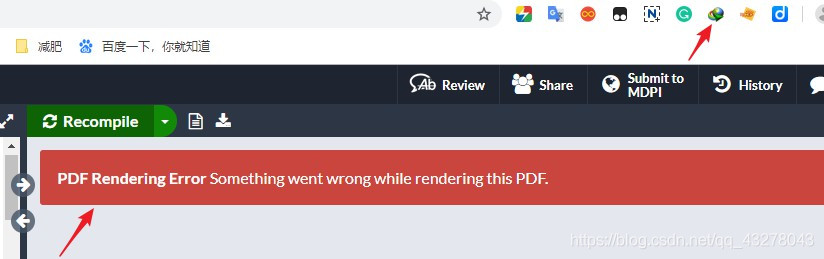
Overleaf PDF Rendering Error Something went wrong while rendering this PDF [How to Solve]

1. Problems

I just came into contact with overleaf . I thought it was very simple, but when I downloaded a template for compilation, I found that I always reported an error:
PDF rendering error something went wrong while rendering this PDF

2. Solutions

Google didn’t find the answer after a while. Later, it thought to itself, why every time there is a PDF download page for IDM , and whether the problem is caused by the IDM plug-in. Sure enough, turned off the IDM plug-in and the problem was solved.

Maven Packaging ERROR: Some problems were encountered while processing the POMs

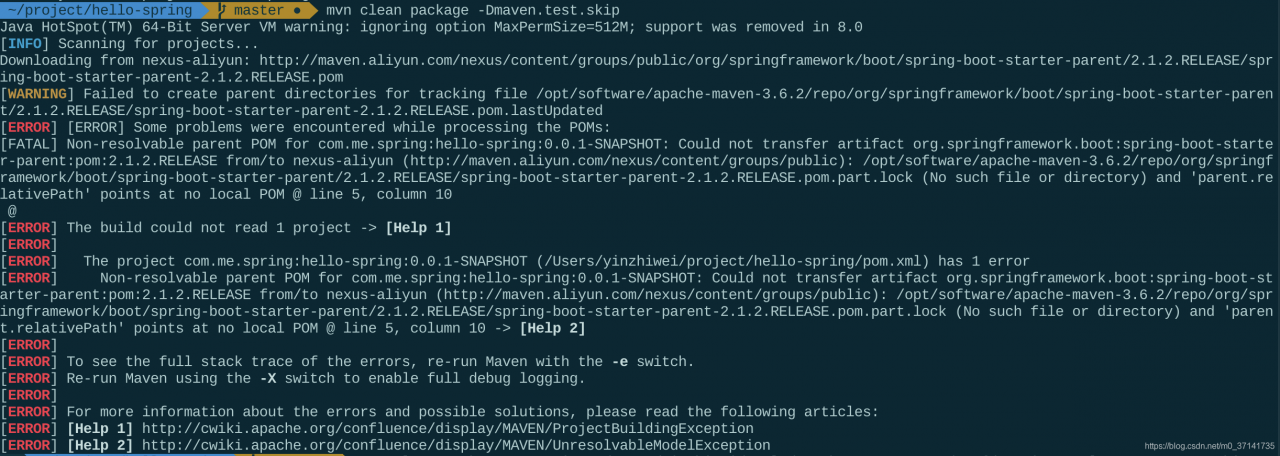
Specific performance in Maven packaging error:

the command used is MVN clean package- Dmaven.test.skip

resolvent

Specifies the settings.xml Configuration file, possibly due to command line execution settings.xml If the file does not match the actual one, use the following command
MVN clean package -- settings{ settings.xml The actual path of}- Dmaven.test.skip

results of enforcement

Android Error:Internal error:org.gradle.tooling.BuildException: Could not execute build…

Android import project compilation error:

Error:Internal error : org.gradle.tooling .BuildException: Could not execute build using Gradle distribution ‘ https://services.gradle.org/distributions/gradle-4.10.1-all.zip ‘.

Problem points:

The version does not match. An error is reported in the figure below

Solution:

Modify its version (just change it to be the same as other local projects)

https\://services.gradle.org/distributions/gradle-4.4-all.zip

error while loading shared libraries: lib*.so: cannot open shared object file: No such file or directory

Error while loading shared libraries: lib *. So: cannot open shared object file: no such file or directory

Error while loading shared libraries: lib *. So: cannot open shared object file: no such file or directory

————————————————————————————————————————————————-

First of all, this topic is a bit long, but it well reflects the problems encountered.

In the article “how to generate two-dimensional code with C code”, Xiaobian also shows you how to compile QRcode correctly_ Test program, run the error problem. Let’s talk about it this time.

At that time, the terminal manual./running program error prompt./QRcode_ test: error while loading shared libraries: libzint.so .2.4: cannot open shared object file: No such file or directory
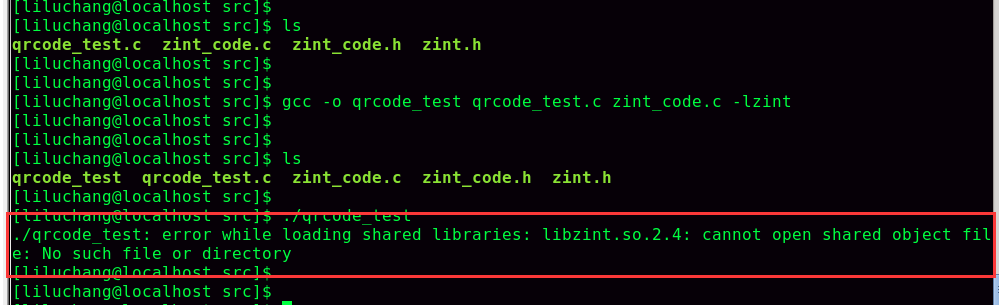
When running the program, you can’t find the information you need libzint.so Dynamic library. As we all know, the biggest difference between the dynamic library and the static library is that the static library is a static link, that is, the implementation of the static library is embedded into the program when the executable file is produced. Once the compilation is successful, the static library will have the value of existence. Even if the static library does not exist, the executable program can run; but the dynamic library is not the same It follows the dynamic link, that is to say, when compiling, you need to specify the path to find the so file link to compile, and when running, you also need to specify the corresponding path to find it. If it is running, the executable program will first go to the default system lib directory to find the so. If it cannot find it, it will report an error: error while loading shared libraries.

In the above paragraph, we talk about how to find the so file when the executable program is running, which is more general

The search paths of dynamic database are as follows

1. The dynamic library search path specified when compiling the object code;

2. Environment variable LD_ LIBRARY_ Path specified dynamic library search path

3. Configuration file/etc/ ld.so.conf The dynamic library search path specified in;

4. The default dynamic library search path is/lib/usr/lib.

Back to the problem of error while loading shared libraries when an executable program is running, in the article “how to generate two-dimensional code with C code”, we also talk about how to avoid this error and run the program. We use the “2. Environment variable LD” mentioned above_ LIBRARY_ Path specified dynamic library search path; “, that is, by setting LD_ LIBRARY_ Path, add the so path used by the current program to LD_ LIBRARY_ Path, so that when the program runs, to LD_ LIBRARY_ The so can be found by searching path. Of course, we have verified the correctness of this method before.
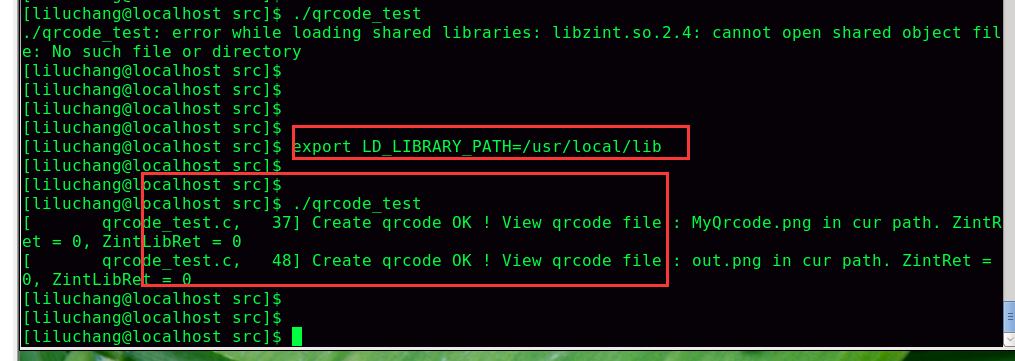
Look, there’s no problem with the program.

If we only introduce this method repeatedly, then the significance of this paper is not great. The greatest significance of this article is to tell readers that we can not set LD_ LIBRARY_ Pat can also run programs, so where should we start?This article mainly introduces, starting from compiling the program.

Here, I will first introduce the compilation options of GCC, but I will not elaborate here. If you are interested, you can learn about it through man GCC, or from the last article of blog [reprint] the parameters and commands commonly used in the use of GCC

Here, the compilation options we need to use are – WL, – rpath; mainly the letter L, not the number 1. -The rpath option tells GCC to write the path of the program to find so to the ELF file when compiling the link. The usage method is that GCC – o outapp *. C – lzint – WL, – rpath = “/ usr/local/lib” or GCC – o outapp *. C – lzint – WL, – rpath – WL, “/ usr/local/lib” are equivalent in function. As shown in the figure below:
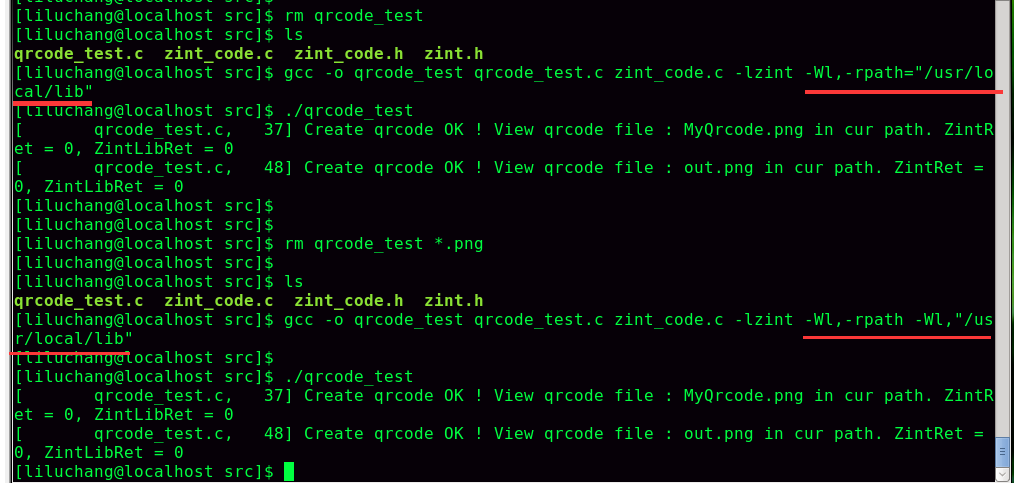
As we can see from the figure, if the program is compiled successfully, it will no longer report error while loading shared libraries. Moreover, the biggest advantage of this method is that after the compilation is successful, the program can run without any settings. Of course, the – rpath parameter passed during compilation must be correct. This method is very useful, especially in cross compiling executable programs of embedded devices. Readers can try it for themselves.

posted @

2016-10-30 01:01

Mr.Recan Reading(

…) comments(

…)

edit

Collection
How to Solve Error creating bean with name ‘log’loginController’

Error Description:

An error occurred during the operation of Maven + SSM project:
A org.springframework.beans . factory.UnsatisfiedDependencyException : error creating bean with name ‘logincontroller’: unsatisfied dependency expressed through field ‘imemberfunction’; as shown in the figure:

Cause of error:

(1) Annotation scanning is not enabled;
(2) the package path of annotation scanning is not set.

resolvent:

(1) In spring- mvc.xml In the configuration file


<mvc:annotation-driven />

(2) In spring- mvc.xml In the configuration file


<context:component-scan base-package="com.bigname.demo03.*" />

Intellij IDEA jetty-jmx.xml Error:Duplicate config file paths found

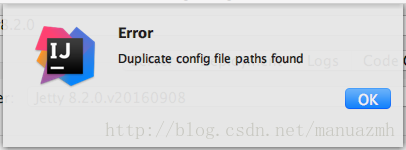
IntelliJ idea configuring jetty- jmx.xml report errors Error:Duplicate config file paths found

Note: IntelliJ idea version: 2016.3.7 for Mac, jetty version: jetty 8.2.0.v20160908.

reason:

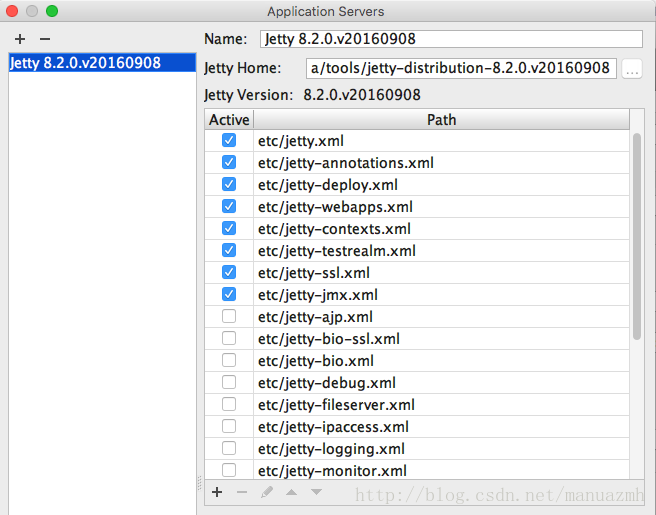
When updating jetty version to jetty 8.2.0.v20160908 today, in configure, in addition to the default configuration file, check etc/jetty- jmx.xml and etc/jetty- ssl.xml when configuring and saving, idea reports an error: Error:Duplicate config File paths found and cannot be saved.

Process:

Try to untick etc/jetty- ssl.xml configuration file, the error remains. Instead, uncheck etc/jetty- jmx.xml , the error disappears. Make sure the error message comes from etc/jetty- jmx.xml configuration file.

solve:

Open the root path of jetty package and find start.ini file, open and pull to the bottom, you can see the list of configuration files that have been checked in the graphical interface, and the last two lines are my additional configuration. In the above heap of configurations in these two lines, you can see that the SSL configuration file has been annotated, but the JMX configuration file has not been annotated, so the configuration file is duplicated. Therefore, in the configuration file of idea, uncheck JMX and confirm start.ini There are no duplicate profiles in .

[How to Solve] Tesorflow: module ‘pandas.core.computation’ has no attribute ‘expressions’

Error Message: Tesorflow:module ‘pandas.core.computation’ has no attribute ‘expressions’

There are totally two methods to solve this error. Let’s check out them.

Method 1:

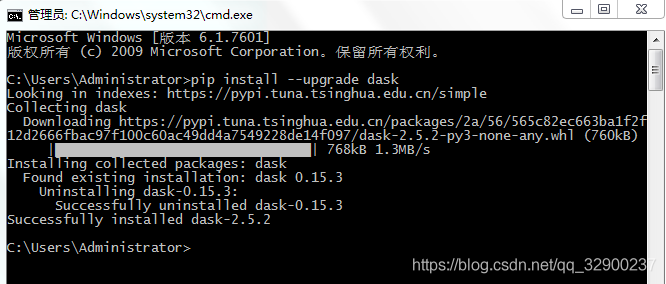
Just upgrade dask, directly under cmd, pip install –upgrade dask, (Pycharm directly enter it in the terminal), and then prompt Successfully installed after completion.

Insert picture description here


Method 2:

This method is a more usable and well-tested.

conda update dask

Tensorflow error: attributeerror: module ‘tensorflow_ API. V1. Train ‘has no attribute’ summarywriter ‘

TensorFlow Error: AttributeError: module ‘tensorflow._api.v1.train’ has no attribute ‘SummaryWriter’ etc.
Analysis: Version update, method call method change
Solution.

Error oRIGINAL METHOD NEW METHOD
AttributeError: module ‘tensorflow._api.v1.train’ has no attribute ‘SummaryWriter’ tf.train.SummaryWriter() tf.summary.FileWriter()
AttributeError: module ‘tensorflow’ has no attribute ‘merge_all_summaries’ tf.merge_all_summaries() tf.summary.merge_all()
AttributeError: module ‘tensorflow’ has no attribute ‘histogram_summary’ tf.histogram_summary() tf.summary.histogram()
AttributeError: module ‘tensorflow’ has no attribute ‘scalar_summary’ tf.scalar_summary() tf.summary.scalar()
AttributeError: module ‘tensorflow’ has no attribute ‘image_summary’ tf.image_summary() tf.summary.image()
AttributeError: module ‘tensorflow’ has no attribute ‘audio_summary tf.audio_summary() tf.summary.audio()
AttributeError: module ‘tensorflow’ has no attribute ‘merge_summary’ tf.merge_summary() tf.summary.merge()