Category Archives: How to Fix

Successfully solved the problem that visual studio code could not go to the definition, and there was no mouse prompt

Visual Studio Code does not prompt the definition I can not solve

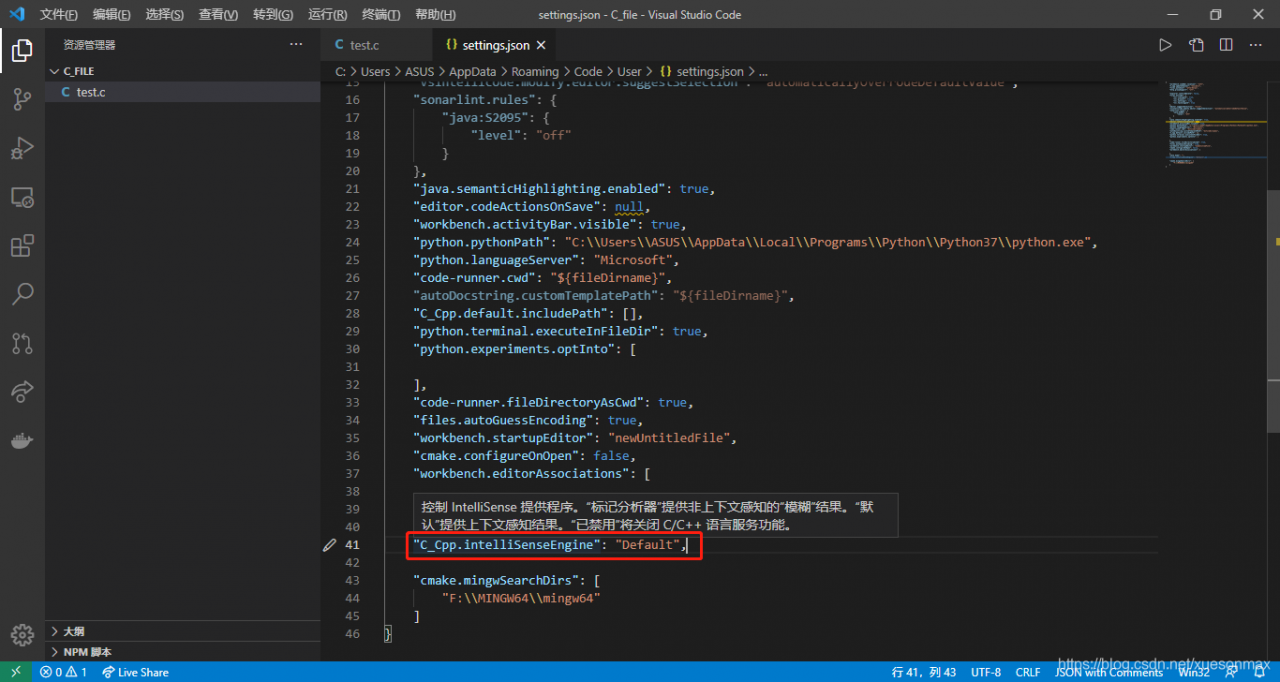
Today suddenly found my vscode without prompt, not even to the definition of function, it was like a TXT text reader, then I have been to install a plug-in, even put vscode uninstall reinstall is useless, I finally in a prompt window to set the configuration file that I have a set of changes over the
I C_Cpp.
the picture intelliSenseEngine was transformed to Disable, lead to code doesn’t provide context awareness, Then change to Default according to the selection prompt

Encapsulation of Ajax JSON / fromdata request in native JS

ajaxPost

function ajaxPost(url,json,cb){
	var xhr = new XMLHttpRequest();
	xhr.open('post',url);
	xhr.setRequestHeader("content-type","application/json");
	xhr.send(JSON.stringify(json));
	xhr.onload = function(){
		cb(JSON.parse(xhr.responseText));
	}
}

Posting pictures

function ajaxPic(formObj,url,cb){
	var formData = new FormData(formObj);
	console.log(formData);
	var xhr = new XMLHttpRequest();
	xhr.open('post',url);
	xhr.send(formData);
	xhr.onload = function(formData){
		cb(JSON.parse(xhr.responseText));
	}
}

java.lang.IllegalArgumentException : URI is not absolute error

Problem phenomena:
After the framework uses SSO (Spring Security OAuth2.0), the Token has been produced. When using the Token to call the interface in Postman, the console appears URI is not absolute error
Analysis of the problem:
Use breakpoints to discover that the URI received in createRequest is empty when the request is created. The first reaction is that there is a problem with the configuration. After checking the YML file, no problem is found

 
In this file, see

@Bean
protected JwtAccessTokenConverter jwtTokenConverter() {
   JwtAccessTokenConverter converter = new JwtAccessTokenConverter();
   converter.setSigningKey("test");
   return converter;
}

After the new step is commented out, add a symmetric key to the corresponding resource service, and use the PostMan call to succeed magically.
Actual reasons for follow-up research…

java.lang.IllegalArgumentException : URI scheme is not “file” error resolution

Java. Lang. IllegalArgumentException: URI scheme is not “file” error

The code in
Map side setup is as follows

        URI[] uris = context.getCacheFiles();
        File file = new File(uris[0]);
        BufferedReader br = new BufferedReader(new InputStreamReader(new FileInputStream(file)));

Code cached in the Driver phase

job.addCacheFile(new URI("/MR/job/input/com.txt"));

After thinking about it and looking for some forums on the Internet, I thought it might be what I wanted to do, but I could not do it with File, so I should do it with Stream.
file f = new file (UI)
le f = new file (UI)
file f = new file (UI)
file f = new file (UI); The file protocol
is now the URL(” http://… “) ) it is impossible to document
so will some changes have been made the setup phase of the code

        URI[] cacheFiles = context.getCacheFiles();
        FileSystem fileSystem = FileSystem.get(cacheFiles[0], context.getConfiguration());
        FSDataInputStream inputStream = fileSystem.open(new Path(cacheFiles[0]));
        BufferedReader br = new BufferedReader(new InputStreamReader(inputStream));

Found that after the change was really good

Vue calculates attributes and passes parameters to the computed method

Vue computes attribute computed that no direct arguments can be passed
You can use closure functions to implement the need to pass parameters

<template>
  <span>{{fmtWeight(1)}}</span>
</template>

<script>
export default {
  data() {
    return {
      weight: 100
    };
  },
  computed: {
    fmtWeight() {
      return num => {
        return this.weight.toFixed(num)
      }
    }
  }
};
</script>

PHP & nbsp; built in server array

$_SERVER[‘PHP_SELF’] $_SERVER[‘PHP_SELF’] $_SERVER[‘PHP_SELF’] $_SERVER[‘PHP_SELF’]
$_SERVER[‘argv’] # Parameters passed to the script.
$_SERVER[‘argc’] # contains the number of command-line arguments passed to the program (if running in command-line mode).
$_SERVER[‘GATEWAY_INTERFACE’] # Version of the CGI specification used by the server. For example, “CGI/1.1”.
$_SERVER[‘SERVER_NAME’] # Host name of the server on which the script is currently running.
$_SERVER[‘SERVER_SOFTWARE’] # The string that identifies the server, given in the header in response to the request.
$_SERVER[‘SERVER_PROTOCOL’] # Name and version of the communication protocol when the page is requested. For example, “HTTP/1.0”.
$_SERVER[‘REQUEST_METHOD’] # Request method for page access. For example: “GET”, “HEAD”, “POST”, “PUT”.
$_SERVER[‘QUERY_STRING’] # $_SERVER[‘QUERY_STRING’] #
$_SERVER[‘DOCUMENT_ROOT’] # The document root where the script is currently running. Define in the server configuration file.
$_SERVER[‘HTTP_ACCEPT’] # The contents of the Accept: header for the current request.
$_SERVER[‘HTTP_ACCEPT_CHARSET’] # Accept-charset: the contents of the header for the current request. For example: “ISO-8859-1,*, UTF-8”.
$_SERVER[‘HTTP_ACCEPT_ENCODING’] # The contents of the Accept-Encoding: header of the current request. For example: “gzip”.
$_SERVER[‘HTTP_ACCEPT_LANGUAGE’]# Accept-language: contents of the header for the current request. For example: “en”.
$_SERVER[‘HTTP_CONNECTION’] # Connection of the current request: the contents of the header. For example: “Keep-Alive”.
$_SERVER[‘HTTP_HOST’] # The contents of the Host: header for the current request.
$_SERVER[‘HTTP_REFERER’] # link to the URL of the previous page of the current page.
$_SERVER[‘HTTP_USER_AGENT’] # Current request User_Agent: contents of header.
$_SERVER[‘HTTPS’] — Set to a non-null value (ON) if accessed over HTTPS, otherwise off
_server [‘REMOTE_ADDR’] # IP address of the user browsing the current page.
$_SERVER[‘REMOTE_HOST’] # Host name of the user browsing the current page.
$_SERVER[‘REMOTE_PORT’] # The port used by the user to connect to the server.
$_SERVER[‘SCRIPT_FILENAME’] $_SERVER[‘SCRIPT_FILENAME’]
$_SERVER[‘SERVER_ADMIN’] # admin information
_server [‘SERVER_PORT’] # port used by server
$>rver [‘SERVER_SIGNATURE’] # string containing the server version and virtual host name.
$_SERVER[‘PATH_TRANSLATED’] # The base path to the file system (not the document root) where the script is currently located.
$_SERVER[‘SCRIPT_NAME’] # This is useful when the page needs to point to itself.
$_SERVER[‘REQUEST_URI’] # The URI required to access this page. For example, “/index.html”.
$_SERVER[‘PHP_AUTH_USER’] # When PHP is running as an Apache module and is using HTTP authentication, this variable is the user name entered by the user.
$_SERVER[‘PHP_AUTH_PW’] # When PHP is running as an Apache module and is using HTTP authentication, this variable is the password entered by the user.
$_SERVER[‘AUTH_TYPE’] # When PHP is running as an Apache module and is using HTTP authentication, this variable is the type of authentication.

Spring error: ora-01017: invalid username / password; login denied

Today, during the integration of Spring and MyBatis, we conducted tests and found that the SQL query could not connect to the database. The exception log is as follows:

org.mybatis.spring.MyBatisSystemException: nested exception is org.apache.ibatis.exceptions.PersistenceException: 
### Error querying database.  Cause: org.springframework.jdbc.CannotGetJdbcConnectionException: Could not get JDBC Connection; nested exception is org.apache.commons.dbcp.SQLNestedException: Cannot create PoolableConnectionFactory (ORA-01017: invalid username/password; logon denied
)
### The error may exist in com/summerzhou/base/mapper/SysuserMapper.xml
### The error may involve com.summerzhou.base.mapper.SysuserMapper.selectByPrimaryKey
### The error occurred while executing a query
### Cause: org.springframework.jdbc.CannotGetJdbcConnectionException: Could not get JDBC Connection; nested exception is org.apache.commons.dbcp.SQLNestedException: Cannot create PoolableConnectionFactory (ORA-01017: invalid username/password; logon denied
)
	at org.mybatis.spring.MyBatisExceptionTranslator.translateExceptionIfPossible(MyBatisExceptionTranslator.java:75)
	at org.mybatis.spring.SqlSessionTemplate$SqlSessionInterceptor.invoke(SqlSessionTemplate.java:371)
	at com.sun.proxy.$Proxy3.selectOne(Unknown Source)
	at org.mybatis.spring.SqlSessionTemplate.selectOne(SqlSessionTemplate.java:163)
	at org.apache.ibatis.binding.MapperMethod.execute(MapperMethod.java:63)
	at org.apache.ibatis.binding.MapperProxy.invoke(MapperProxy.java:43)
	at com.sun.proxy.$Proxy4.selectByPrimaryKey(Unknown Source)
	at com.summerzhou.test.TestClass.findUserById(TestClass.java:27)
	at sun.reflect.NativeMethodAccessorImpl.invoke0(Native Method)
	at sun.reflect.NativeMethodAccessorImpl.invoke(NativeMethodAccessorImpl.java:57)
	at sun.reflect.DelegatingMethodAccessorImpl.invoke(DelegatingMethodAccessorImpl.java:43)
	at java.lang.reflect.Method.invoke(Method.java:606)
	at org.junit.runners.model.FrameworkMethod$1.runReflectiveCall(FrameworkMethod.java:47)
	at org.junit.internal.runners.model.ReflectiveCallable.run(ReflectiveCallable.java:12)
	at org.junit.runners.model.FrameworkMethod.invokeExplosively(FrameworkMethod.java:44)
	at org.junit.internal.runners.statements.InvokeMethod.evaluate(InvokeMethod.java:17)
	at org.junit.internal.runners.statements.RunBefores.evaluate(RunBefores.java:26)
	at org.junit.runners.ParentRunner.runLeaf(ParentRunner.java:271)
	at org.junit.runners.BlockJUnit4ClassRunner.runChild(BlockJUnit4ClassRunner.java:70)
	at org.junit.runners.BlockJUnit4ClassRunner.runChild(BlockJUnit4ClassRunner.java:50)
	at org.junit.runners.ParentRunner$3.run(ParentRunner.java:238)
	at org.junit.runners.ParentRunner$1.schedule(ParentRunner.java:63)
	at org.junit.runners.ParentRunner.runChildren(ParentRunner.java:236)
	at org.junit.runners.ParentRunner.access$000(ParentRunner.java:53)
	at org.junit.runners.ParentRunner$2.evaluate(ParentRunner.java:229)
	at org.junit.runners.ParentRunner.run(ParentRunner.java:309)
	at org.eclipse.jdt.internal.junit4.runner.JUnit4TestReference.run(JUnit4TestReference.java:86)
	at org.eclipse.jdt.internal.junit.runner.TestExecution.run(TestExecution.java:38)
	at org.eclipse.jdt.internal.junit.runner.RemoteTestRunner.runTests(RemoteTestRunner.java:538)
	at org.eclipse.jdt.internal.junit.runner.RemoteTestRunner.runTests(RemoteTestRunner.java:760)
	at org.eclipse.jdt.internal.junit.runner.RemoteTestRunner.run(RemoteTestRunner.java:460)
	at org.eclipse.jdt.internal.junit.runner.RemoteTestRunner.main(RemoteTestRunner.java:206)

The user/password is not valid. I have tried Oracle and the password is correct. Then check db.properties to see that the username and password are correct

driverClassName=oracle.jdbc.driver.OracleDriver
url=jdbc:oracle:thin:@192.168.25.129:1521:orcl
username=tommy
password=***

Use the Spring Framework to get a DataSource instance. Check the userName of the DataSource and find that the result is X, not Tommy specified in the DB file.

    @Test
    public void setDateSource() {
		BasicDataSource dataSource = (BasicDataSource) applicationContext.getBean("dataSource");
		System.out.println(dataSource.getUsername());
    }

I suddenly realized that x was the username of my native. I looked it up. context:property-placeholder> Is used to activate “${} placeholder, parsing the location attribute defined in the file, generated a accomplished instance, accomplished to externalize based on Java properties format defined properties, and can make the programmer to customize the specific environmental properties, such as a database url and password, so that we can only change the corresponding properties file, without affecting framework.
in my definition of db. The properties, the user name of the key for the username, dataSource injection of attribute value is ${username}, but this username is not the values in the file. Because is accomplished not only in the specified attributes defined in the properties file, also will check the properties in the Java runtime environment. We can customize the order in which the properties are checked by the system-properties-mode property, which has four values:
1) ENVIRONMENT: default property, which is read in the runtime first, or in the properties file specified in the location if the specified property value is not obtained.
2) None: Never check the system properties, only resolve the properties file
) Override: system-local properties
4>allback: properties before system
In conclusion, there are two solutions:
1. The key from the properties file before fully coupled with JDBC., so when reading properties don’t conflict with system properties

jdbc.driverClassName=oracle.jdbc.driver.OracleDriver
jdbc.url=jdbc:oracle:thin:@192.168.25.129:1521:orcl
jdbc.username=tommy
jdbc.password=****

DataSource injection changed to:

<bean id="dataSource" class="org.apache.commons.dbcp.BasicDataSource" destroy-method="close">
	<property name="driverClassName" value="${jdbc.driverClassName}"></property>
	<property name="url" value="${jdbc.url}"></property>
	<property name="username" value="${jdbc.username}"></property>
	<property name="password" value="${jdbc.password}"></property>
</bean>

2. Will & lt; context:property-placeholder> Change the system-properties-mode to None or Fallback
Invalid username / password; login denied

The following error message was sent when connecting to the database

16:10:47.547 [Druid-ConnectionPool-Create-574835454] ERROR c.alibaba.druid.pool.DruidDataSource - create connection SQLException, url: jdbc:oracle:thin:@192.168.1.2:1521:orcl, errorCode 1017, state 72000
java.sql.SQLException: ORA-01017: invalid username/password; logon denied
    at oracle.jdbc.driver.T4CTTIoer.processError(T4CTTIoer.java:447) ~[ojdbc-6.jar:11.2.0.3.0]
    at oracle.jdbc.driver.T4CTTIoer.processError(T4CTTIoer.java:389) ~[ojdbc-6.jar:11.2.0.3.0]
    at oracle.jdbc.driver.T4CTTIoer.processError(T4CTTIoer.java:382) ~[ojdbc-6.jar:11.2.0.3.0]
    at oracle.jdbc.driver.T4CTTIfun.processError(T4CTTIfun.java:675) ~[ojdbc-6.jar:11.2.0.3.0]
    at oracle.jdbc.driver.T4CTTIoauthenticate.processError(T4CTTIoauthenticate.java:448) ~[ojdbc-6.jar:11.2.0.3.0]
    at oracle.jdbc.driver.T4CTTIfun.receive(T4CTTIfun.java:513) ~[ojdbc-6.jar:11.2.0.3.0]
    at oracle.jdbc.driver.T4CTTIfun.doRPC(T4CTTIfun.java:227) ~[ojdbc-6.jar:11.2.0.3.0]
    at oracle.jdbc.driver.T4CTTIoauthenticate.doOAUTH(T4CTTIoauthenticate.java:383) ~[ojdbc-6.jar:11.2.0.3.0]
    at oracle.jdbc.driver.T4CTTIoauthenticate.doOAUTH(T4CTTIoauthenticate.java:776) ~[ojdbc-6.jar:11.2.0.3.0]
    at oracle.jdbc.driver.T4CConnection.logon(T4CConnection.java:432) ~[ojdbc-6.jar:11.2.0.3.0]
    at oracle.jdbc.driver.PhysicalConnection.<init>(PhysicalConnection.java:553) ~[ojdbc-6.jar:11.2.0.3.0]
    at oracle.jdbc.driver.T4CConnection.<init>(T4CConnection.java:254) ~[ojdbc-6.jar:11.2.0.3.0]
    at oracle.jdbc.driver.T4CDriverExtension.getConnection(T4CDriverExtension.java:32) ~[ojdbc-6.jar:11.2.0.3.0]
    at oracle.jdbc.driver.OracleDriver.connect(OracleDriver.java:528) ~[ojdbc-6.jar:11.2.0.3.0]
    at com.alibaba.druid.filter.FilterChainImpl.connection_connect(FilterChainImpl.java:149) ~[druid-1.1.9.jar:1.1.9]
    at com.alibaba.druid.filter.stat.StatFilter.connection_connect(StatFilter.java:218) ~[druid-1.1.9.jar:1.1.9]
    at com.alibaba.druid.filter.FilterChainImpl.connection_connect(FilterChainImpl.java:143) ~[druid-1.1.9.jar:1.1.9]
    at com.alibaba.druid.filter.FilterAdapter.connection_connect(FilterAdapter.java:786) ~[druid-1.1.9.jar:1.1.9]
    at com.alibaba.druid.filter.FilterChainImpl.connection_connect(FilterChainImpl.java:143) ~[druid-1.1.9.jar:1.1.9]
    at com.alibaba.druid.filter.stat.StatFilter.connection_connect(StatFilter.java:218) ~[druid-1.1.9.jar:1.1.9]
    at com.alibaba.druid.filter.FilterChainImpl.connection_connect(FilterChainImpl.java:143) ~[druid-1.1.9.jar:1.1.9]
    at com.alibaba.druid.pool.DruidAbstractDataSource.createPhysicalConnection(DruidAbstractDataSource.java:1515) ~[druid-1.1.9.jar:1.1.9]
    at com.alibaba.druid.pool.DruidAbstractDataSource.createPhysicalConnection(DruidAbstractDataSource.java:1578) ~[druid-1.1.9.jar:1.1.9]
    at com.alibaba.druid.pool.DruidDataSource$CreateConnectionThread.run(DruidDataSource.java:2466) ~[druid-1.1.9.jar:1.1.9]

The solution is as follows:
${username}code>${username} ${username} ${username} ${username} ${username} ${username} Or you can use the following system-properties-modeoperty when referring to the configuration file

<context:property-placeholder location="classpath:jdbc.properties" system-properties-mode="FALLBACK" />

Solution of invalid username / password; login denied error in Oracle Database Foundation

A invalid username/password; CMD must be run as administrator in win7 or win8

1. Enter command under DOS:
SQLPLUS SYS/Password set at installation as SYSDBA
(enter)

2. Then type the command:
alter user scott account unlock;
 

When you enter, the words “User has changed” will appear, and you can move on to the next step.  

3. Enter the command:
conn scott/tiger
 

After entering, an error message (as follows) will appear:

ERROR:
ORA-28001: The password has expired
 

Change Scott’s password

New password:

4. Enter a new password;  

5. Repeat the new password.  

Finally, there you go!

Reproduced in: https://www.cnblogs.com/dfyg-xiaoxiao/p/7213772.html

Solution to the error “tcnative-1.dll: can’t load amd 64 bit. DLL on IA 32 bit platform”

Operating system: Win8-64
Application server: apache-tomcat-7.0.59, 64-bit
Development tool: MyEclipse-8, 32-bit
The JDK: JDK – 6 u45 – Windows – x64
After integrating Tomcat into MyEclipse, launch the Times error:

You can download a 32-bit tcnative 1.dll file and replace it with the same name file in the bin folder of the original Tomcat folder. You can restart Tomcat.