The problem of “OLE DB encountered error 0x80004005 “when using BarTender printing barcode
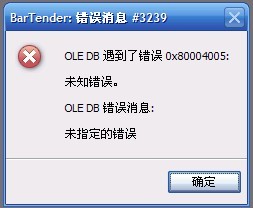
Just close the Excel file that the database is connected to when printing
Author Archives: Robins
Error resolution: Error: redefinition of class xxx
Error: Redefinition of class XXX
Generally, an error redefinition of class XXX occurs, and there is also an error previous definition of class XXX
Erratum:
In general, the reason for the error is that #ifndef, #define, and #endif are not used in the header file (.h) of the class definition. In other words, there is no macro to prevent the class from being included multiple times.
Alternatively, you may have defined the class repeatedly, so take a closer look at your code to see if there are any duplicate definitions.
Modification:
Add macros for classes that prevent being included more than once:
#ifndef _BASESMOOTHINGALGORITHM_H_
#define _BASESMOOTHINGALGORITHM_H_

#include "BaseSmoothingAlgorithm.h"

#endif
Mysql reports an error Operand should contain 1 column(s)
Mysql error Operand should contain 1 column(s)
1. An error
ERROR 1241 (21000): Operand should contain 1 column(s)
2. Report the cause of the error
This statement mostly occurs because the result set of the SELECT is wrapped in (). It is normal to enclose () with select, but it is possible that the fields are misused, as shown in the following SQL:
select
 pit_key
,employee_code
,department_id
,value_date
from pit_employee_department ped
where ped.employee_code = 'GSCQ3349'
and ped.value_date < date_format(date_sub(curdate(), interval day(curdate()) - 1 day),'%Y%m%d')
and ped.pit_key not in
(	select
	pit_key
	,value_date
	from pit_employee_department ped_1
	inner join
	(
		select
		max(value_date) as max_date
		from pit_employee_department ped

		where ped.value_date <= date_format(date_sub( date_sub(curdate(), interval day(curdate()) - 1 day),interval 1 month),'%Y%m%d')
		and employee_code = 'GSSH0039'
	)ped_2
	on ped_1.value_date < ped_2.max_date
	and ped_1.employee_code = 'GSSH0039'
);
The reason for executing this error in the above SQL statement is that pit_key and value_date are used in the subquery, and the comparison option is pit_key not in (...). , field inconsistency results in an error.
3. Solutions
Make changes for different reasons.
ssh-copy-id:/usr/bin/ssh-copy-id: ERROR: No identities found
1 Generate public-private key pairs
[atguigu@hadoop102 .ssh]$ ssh-keygen -t dsa
Generating public/private dsa key pair.
Enter file in which to save the key (/home/atguigu/.ssh/id_dsa):
Enter passphrase (empty for no passphrase):
Enter same passphrase again:
Your identification has been saved in /home/atguigu/.ssh/id_dsa.
Your public key has been saved in /home/atguigu/.ssh/id_dsa.pub.
The key fingerprint is:
25:0a:23:7f:a7:f0:d1:78:f6:59:57:e3:cc:78:49:d0 atguigu@hadoop102
The key's randomart image is:
+--[ DSA 1024]----+
|             ..  |
|              .E |
|  . o   . .    o.|
|   o o + o    *.o|
|    o = S   ...* |
|     + * . o ..  |
|      o   o      |
|                 |
|                 |
+-----------------+
[atguigu@hadoop102 .ssh]$ ssh-copy-id hadoop103
/usr/bin/ssh-copy-id: ERROR: No identities found
After regenerating the key pair, it was copied to another machine, HadoOP103 times made the following mistake:
/usr/bin/ssh-copy-id: ERROR: No identities foundThe reason mentioned online is that no key pair has been generated.
Obviously, I am not the reason, as mentioned below:
Then it is found that the public key path is missing and can be added through -i:
$ ssh-copy-id -i ~/.ssh/id_dsa.pub user@remote_ip
I tried it, and I solved it
[atguigu@hadoop102 .ssh]$ ssh-copy-id -i ~/.ssh/id_dsa.pub atguigu@hadoop103
atguigu@hadoop103's password:
Now try logging into the machine, with "ssh 'atguigu@hadoop103'", and check in:

  .ssh/authorized_keys

to make sure we haven't added extra keys that you weren't expecting.

[atguigu@hadoop102 .ssh]$ ssh-copy-id -i ~/.ssh/id_dsa.pub atguigu@hadoop104
atguigu@hadoop104's password:
Now try logging into the machine, with "ssh 'atguigu@hadoop104'", and check in:

  .ssh/authorized_keys

to make sure we haven't added extra keys that you weren't expecting.

[atguigu@hadoop102 .ssh]$ ssh hadoop104
Last login: Fri Dec 28 03:39:18 2018 from 192.168.31.1
[atguigu@hadoop104 ~]$ exit
logout
Connection to hadoop104 closed.
[atguigu@hadoop102 .ssh]$ ssh hadoop103
Last login: Fri Dec 28 03:39:18 2018 from 192.168.31.1
[atguigu@hadoop103 ~]$ exit
logout
Connection to hadoop103 closed.
There was a problem with the editor ‘vi’
There was a problem with the editor ‘vi’
submitted the code through
git commit-m 'modify message' in the project. It was found that the modify message submitted was not accurate, so I wanted to modify it. Use the git commit -amend command to modify modify message. After editing the message in vim, the w+q exits with an error and the 0 message1 fails to save, 2The error message is:

error: There was a problem with the editor 'vi'.
 Please supply the message using either -m or -F option.
Solutions:

git config --global core.editor /usr/bin/vimAmend git commit --amend is OK this time.
Reference:
http://tooky.co.uk/there-was-a-problem-with-the-editor-vi-git-on-mac-os-x/
The installation of Homebrew encountered a 400 Bad Request error
The following command is used to install Homebrew today:
ruby -e “$(curl -fsSL https://raw.github.com/mxcl/homebrew/go)”
appear
Curl: (22) The requested URL returned error: 400 Bad Request
error, search The following command to successfully install:
ruby -e “$(curl -fsSL https://raw.github.com/mxcl/homebrew/go)”
appear
Curl: (22) The requested URL returned error: 400 Bad Request
error, search The following command to successfully install:
ruby -e “$(curl -fsSL https://raw.githubusercontent.com/Homebrew/install/master/install)”
tftp open error resolution
Error message:
Can’t bind the TFTP port!
Solutions:
Check to see if port 69 is occupied by netstat -AN
2 If it is not occupied, delete the TFTPD32 folder under HKEY_LOCAL_MACHINE, SOFTWARE in the registry
Restart the tftp32
Can’t bind the TFTP port!
Solutions:
Check to see if port 69 is occupied by netstat -AN
2 If it is not occupied, delete the TFTPD32 folder under HKEY_LOCAL_MACHINE, SOFTWARE in the registry
Restart the tftp32
error C2057: expected constant expression (Can the size of an array in C language be defined when the program is running?)
Can the size of an array be defined at run time?
no. In the definition of an array, the size of the array must be known at compile time, not at run time. For example, if I is a variable, you cannot use I to define the size of an array:
char array[I]; Notvalidc */
supports this definition in some languages, but not in C. If C supported this definition, the stack would become more complex, the overhead of calling functions would be greater, and the program would run significantly slower.
if the size of the array is known at compile time, even if it is a very complex expression, you can define it as long as it can be calculated at compile time. If you want to use an array whose size is not known until the program is running, you can specify a pointer and call the malloc() or calloc() functions to allocate memory space for the array from the heap. Here is an example of an argv array that is copied to the main() function:
no. In the definition of an array, the size of the array must be known at compile time, not at run time. For example, if I is a variable, you cannot use I to define the size of an array:
char array[I]; Notvalidc */
supports this definition in some languages, but not in C. If C supported this definition, the stack would become more complex, the overhead of calling functions would be greater, and the program would run significantly slower.
if the size of the array is known at compile time, even if it is a very complex expression, you can define it as long as it can be calculated at compile time. If you want to use an array whose size is not known until the program is running, you can specify a pointer and call the malloc() or calloc() functions to allocate memory space for the array from the heap. Here is an example of an argv array that is copied to the main() function:
[cpp]
view plain
copy
- 7.15 cases in row to determine the size of the array, use the pointer and the malloc ()/* A silly program that copies the argv array and all the pointed – to strings. Just for fun, it also deallocates all the copies. */# include & lt; Stdlib. H> # include & lt; String. H> Int main (int arg c, char * * argv) {char * * new_argv; Int I;/* Since argv [0] through argv [arg c] are all valid, the program needs to the allocate room for arg c + 1 Pointers. */new_argv = (char * *) calloc (arg c + l, sizeof (char *));/* or malloc ((arg c + 1) * sizeof (char *)) */printf (” allocated room for % d Pointers starting at % P \ n “, arg c + 1, new_argv);/* now copy all the strings more (argv [0] through argv [arg c – l]) */for (I = 0; i< argc; + + I) {/ * make room for ‘\ 0’ at end, too */new_argv [I] = (char *) malloc (strlen (argv [I]) + l); Strcpy (new_argv [I], argv [I]); Printf (” % d bytes allocated for new_argv [% d] at % P “, “copied \” % s \ \ “n”, strlen (argv [I]) + l, I, new_argv [I], new_argv [I]); } new_ argv [arg c] = NULL:/* To deallocate everything, get rid of the strings (in any order), then the array of Pointers. If you free the array of poiners first, you lose all the reference To t (I = 0); i< argc; + + I) {free (new_argv [I]); Printf (” freed new_argv [% d] at % P \ n “, I, new_argv [I]); Argv [I] = NULL; * * Habit, see note at the end of this example */} free(new_argv); Printf (” Freed new_argv itself at %P\n”, new_argv); Return 0; /* see 16.4 */}
Note: Why does example 7.5 assign NULL after freeing each element in the new_argv array?This is a habit formed on the basis of long practice. After a pointer is released, you can no longer use the data it originally pointed to, or the pointer is “suspended” and no longer points to any useful data. If a pointer is assigned NULL immediately after it is released, the program will not make an error even if it USES the pointer again. Of course, the program may indirectly refer to the null pointer, but such errors can be detected in time while debugging the program. In addition, a
program may still have some original copies of the pointer pointing to the portion of memory that has been freed, which is natural in C programs. In short, although this habit doesn’t solve all problems, it does help.
Linux7 hardware time occasionally encounter nonsense Powerpath startup error
New environment, RHEL 7.2 installs EMPPP multipath software
But after starting, an ERROR
, Nov 14 10:44:46 localhost PowerPathPost: ERROR: Cannot open PowerPath. Initialization ERROR
, Nov 14 10:44:46 localhost PowerPathPost: ERROR: Cannot open PowerPath
Later, I checked EMC’s official website and found relevant bugs, because the hardware time and system time did not match. When the PP starts, it needs to be initialized. Hwoo-w synchronization time, and restart the host after normal.
https://community.emc.com/docs/DOC-60879
Reproduced in: https://blog.51cto.com/yangjunfeng/2316861
Use of rep function in R
The official help document reads as follows:
Usage
rep(x, ...)

rep.int(x, times)

rep_len(x, length.out)
Arguments
x |
a vector (of any mode including a list) or a factor or (for rep only) A POSIXct or POSIXlt or Date object; or an S4 object containing such an object. |
||||
... |
further arguments to be passed to or from other methods. For the internal default method these can include:
| times
length.out non-negative integer: the desired length of the output vector. |
|
Rep functions with four parameters: the x vector or class vector of objects, each: x elements each repetitions, times: after each vector processing, if The Times is a single value, is the value of the whole after each repeat number of times, if it is equal to the vector x after each of the length of the vector, for each of the number of the elements of the repeat times each element in the same position, otherwise an error; Leng. out refers to the length of the final output of the vector processed by times. If it is longer than the generated vector, it is completed. That is, rep will take each parameter, generate a vector X1, and times will manipulate X1 to generate X2, lengthen. Out will manipulate X2 to produce the final output vector X3. Here is an example:
> Rep (1:4,times=c(1,2,3,4)) # and vector x equal length times mode
[1] 1 2 2 3 3 3 4 4 4 4
> Rep (1:4,times=c(1,2,3)) # non-equilong mode, Error
Error in rep(1:4,times=c(1,2,3)) : invalid 'times' argument
> Rep (1:4,each=2,times=c(1,2,3,4)) # is still non-equal length mode, because the vector after each has 8 bits, instead of 4 bits
Error in rep(1:4,each=2,times=c(1,2,3,4)) :
invalid 'times' argument
> Rep (1:4, times = c (1, 2, 3, 4)) # isometric model, I wrote to the o (╯/╰) o
[1] 1 2 2, 3, 3, 3, 4, 4 4 4
& gt; Rep (1:4,times=c(1,2,3,4),each=3) # repeat example, don't beat me
Error in rep(1:4,times=c(1,2,3,4),each=3) :
invalid 'times' argument
> Rep (1:4, each = 2, times = 8) # value correctly, times8 bit length vector
[1] 1 1 1 2 2 2 2 2 2 2, 3, 3 3 3 3 3 3 3 3 3, 3, 4, 4 4 4 4 4 4 4 4 4 4 4 4 4 4
& gt; Rep (1:4,each=2,times=1:8,len=3) # use of len, loop complement pay attention to
[1] 1 1 2
> Rep (1:4,each=2,times=3) # after each times
[1] 1 1 2 2 3 3 4 4 1 1 2 2 3 3 4 4 4 1 1 2 2 3 3 3 4 4
> Rep function over!
Reproduced in: https://www.cnblogs.com/business-analysis/p/3414997.html
error C2471: cannot update program database vc90.pdb
Why is it that after I convert a VC6 project to a VS2008 project, the compilation always fails to find and cannot upgrade the VC90.pDB file?Recompiling doesn’t work either.
jump directly from VC6 to VS2008
This VS2008 is a well-known bug. See https://connect.microsoft.com/VisualStudio/feedback/ViewFeedback.aspx?for details FeedbackID=309462
The official current solution is as follows:
I have found an alternate way for the time beging to avoid C2471 error but it works only in the case of successful release build.
for this click build menu than Configuration manager than create a new setting from release settings. Change following things in your project settings as :
C\C++ | General | Debug Information format | C7 Compatible (/Z7)
C\C++ | Code Generation | Enable String Pooling | Yes (/GF)
Linker |Debuging |General Debug Info | Yes (/DEBUG)
Reproduced in: https://www.cnblogs.com/kex1n/archive/2012/01/14/2322164.html
unity fatal error in gc too many heap sections error
The project will upgrade the Unity version in the next two days. For fear of making mistakes, I will directly copy the original project files to the new directory. Unity Fatal error in GC Too Many Heap Sections was reported in the compiled script of the project importing the new directory in the new version of Unity. The project could be opened in Unity without being closed, but the script could not be compiled. The Unity Fatal error in GC too many heap sections was reported in the compiled script. If you don’t understand, go online and look up information. First go big Baidu, searched a circle, someone said that 360’s reason, tried not to do. Go to Otani again, still fail. You’d better figure it out yourself. File-> Builder Settings Switching platform. Done! (PS, I’m from Android-& GT; Windows,Windows-> Android).