Category Archives: Error

Visual Studio SignTool Error: No certificates were found that met all the given criteria.

Problem: If there is a problem with the Virtual Studio certificate or signtool.exe signing tool, this error is reported when the project is compiled and run.
Solution: Refer to the following.

http://stackoverflow.com/questions/22946399/signtool-error-no-certificates-were-found-that-met-all-given-criteria-with-a-wi
https://social.msdn.microsoft.com/Forums/windows/en-US/26e4991e-5210-4005-aac9-722951652b39/signtool-error-no-certificates-were-found-that-met-all-the-given-criteria?forum=winformssetup
http://blog.csdn.net/gnodiuhnil/article/details/4667496

[VS2015] “An error occurred while signing: SignTool.exe not found”


http://www.vbdotnetforums.com/vb-net-general-discussion/60240-failed-sign-bin-debug-app-publish-setup-exe-signtool-error-no-certificates.html

And instructions on signtool.exe:

https://msdn.microsoft.com/en-us/library/8s9b9yaz.aspx


SignTool Download Address:

http://download.csdn.net/download/larker588/3066687

A mistake about implicitly providing default constructors

As many C++ textbooks say, “if a class is defined and no constructor is provided, the compiler will implicitly provide a default constructor.”

the following excerpt from the original document of ISO C++ 99:

The default constructor (12.1), copy constructor and copy assignment operator (12.8), and destructor (12.4)

are special member functions. The implementation will
implicitly declare these member functions for a

class type
1. When the program does not declare explicitly them, except as noted in 12.1

will
implicitly define them
If they are used, as specified in 12.1, 12.4 and 12.8.

A default constructor for a class X is a constructor of class X that can be called without an argument. If

there is no user-declared constructor for class X, a default constructor is
implicitly declared. An implicitly-

declared default constructor is an
inline public member of its class.

An implicitly-declared default constructor for a class is
implicitly defined when
it is used to create an object

Declared -defined default constructor, everyone The set of Initializations of The

class that would be performed by a user-written default constructor for that class with
An Empty Meminitial-List (12.6.2) and an Empty Function body. If that user-written default constructor would be illformed,the program is ill-formed. Before the declared -declared default constructor for a class is implicitly

defined, all the implicitly-declared default constructors for its base classes and its nonstatic data members

shall have been implicitly defined. [Note: an implicitly-declared default constructor has an exceptionspecification(15.4).

the following excerpts from “corrigendum to sun xin vc tutorial” :

I said, “C++ also states that if a class does not provide any constructors, then C++ provides a default constructor (provided by the C++ compiler).” this statement is also incorrect, and correct:
If no constructor is defined in a class, the compiler will provide a default constructor only if:
1. If the class has virtual member functions or virtual inheritance parent class (i.e., virtual base class);
2. If the base class of the class has a constructor (either a user-defined constructor or a default constructor provided by the compiler);
3. All non-static object data members in a class that have constructors in their corresponding class (either user-defined constructors or default constructors provided by the compiler).
There are also such words in C++ Primer 14.2:

new users often mistakenly assume that if a default constructor does not exist, the compiler automatically generates a default construct

builds functions and applies them to objects to initialize the data members of the class, for the Account class we define

is not true, and the system neither generates the default constructor nor calls it. For those that contain a class data member or inheritance
The
more complex class, which is partially true, may generate a default constructor, but it will not be built-in or complex
Data members of the
combination, such as Pointers or arrays, provide an initial value.

can also be analyzed from the bottom layer:

C/C++ code


    class
     A
{
    public
    :
        
    int
     a;
        
    char
     
    *
    ptr;
};

    int
     main()
{
        A a;
        
    return
     
    0
    ;
}

The

code does not produce the default ctor, so the class looks like a struct under C, and none of the members need to be initialized.

evidence 1:

Assembly code


    97
    :   
    int
     main()
    98
    :   {
    0040D680
       
    push
            ebp
    0040D681
       
    mov
             ebp,esp
    0040D683
       
    sub
             esp,48h
    0040D686
       
    push
            ebx
    0040D687
       
    push
            esi
    0040D688
       
    push
            edi
    0040D689
       
    lea
             edi,[ebp-48h]
    0040D68C
       
    mov
             ecx,12h
    0040D691
       
    mov
             eax,0CCCCCCCCh
    0040D696
       
    rep
     stos    dword ptr [edi]  
    99
    :       A a
    ;
                      //Nothing to do
    
    100
    :      return 
    0
    ;
    0040D698
       
    xor
             eax,eax
    101
    :  }
    0040D69A
       
    pop
             edi
    0040D69B
       
    pop
             esi
    0040D69C
       
    pop
             ebx
    0040D69D
       
    mov
             esp,ebp
    0040D69F
       
    pop
             ebp
    0040D6A0
       
    ret
     

</ dl> however,

(1) if a member variable that requires a constructor is added, the default ctor is called, such as STD ::string

C/C++ code


#include 
    <
    string
    >
    
    class
     A
{
    public
    :
    
    int
     a;
    
    char
     
    *
    ptr;
    std::
    string
     test;
};

    int
     main()
{
    A a;
    
    return
     
    0
    ;
}
Assembly code


        int
         main()
        99
        :   {
        0040D680
           
        push
                ebp
        0040D681
           
        mov
                 ebp,esp
        0040D683
           
        sub
                 esp,5Ch
        0040D686
           
        push
                ebx
        0040D687
           
        push
                esi
        0040D688
           
        push
                edi
        0040D689
           
        lea
                 edi,[ebp-5Ch]
        0040D68C
           
        mov
                 ecx,17h
        0040D691
           
        mov
                 eax,0CCCCCCCCh
        0040D696
           
        rep
         stos    dword ptr [edi]
        100
        :      A a
        ;
        0040D698
           
        lea
                 ecx,[ebp-18h]
        ;
        this Pointer
        
        0040D69B
           
        call
                @ILT+
        35
        (
        A:
        :A) (
        00401028
        )
        ;
        The defaultctor is called.
        
        101
        :      return 
        0
        ;
        0040D6A0
           
        mov
                 dword ptr [ebp-1Ch],
        0
        
        0040D6A7
           
        lea
                 ecx,[ebp-18h]
        0040D6AA
           
        call
                @ILT+
        40
        (
        A:
        :~A) (
        0040102d
        )
        0040D6AF
           
        mov
                 eax,dword ptr [ebp-1Ch]
        102
        :  }
        0040D6B2
           
        pop
                 edi
        0040D6B3
           
        pop
                 esi
        0040D6B4
           
        pop
                 ebx
        0040D6B5
           
        add
                 esp,5Ch
        0040D6B8
           
        cmp
                 ebp,esp
        0040D6BA
           
        call
                __chkesp (
        00401170
        )
        0040D6BF
           
        mov
                 esp,ebp
        0040D6C1
           
        pop
                 ebp
        0040D6C2
           
        ret
         

(2) has a virtual function and will call the default ctor, such as:

C/C++ code

 [code
    =
    C
    /
    C
    ++
    ]
class A
{
public:
    int a;
    char *ptr;
    virtual void dd(){a=1;}
};

int main()
{
    A a;
    return 0;
}


corresponding Assembly

Assembly code


    100
    :      A a
    ;
    00401048
       
    lea
             ecx,[ebp-0Ch]
    0040104B
       
    call
            @ILT+
    15
    (
    A:
    :A) (
    00401014
    )
    ;
    The main thing here is to put the first address of the virtual function table into the first four bytes.
     

can be summarized as follows: the compiler always produces the default ctor when it is needed and when the user does not provide it. Doing so yields optimal efficiency.
Angularjs1 exception error:[$injector:unpr]

Injector: [$Injector: UNPR]

<html>

    <head>
        <meta http-equiv="content-type" content="text/html; charset=UTF-8">
        <meta name="viewport" content="width=device-width, minimum-scale=1.0, maximum-scale=1.0, user-scalable=0" />
        <script type="text/javascript" src="js/angular.min.1.3.6.js"></script>


    </head>

    <body ng-app='myapp1'>
        <cus></cus>

    </body>
    <script type="text/javascript">
        var app = angular.module('myapp1', []);

        //Throw this exception, the problem is in this piece of code: here the function's argument is passed in more than $scope, and after removing it, the exception is resolved
        // Running this exception means there is a problem with the injected content, and when you encounter a similar exception, check if the injected content is correct!

        app.directive("cus",function($scope){
            return function(scope,element,attrs){
                console.log('返回element=='+element);
            }
        });


    </script>

</html>

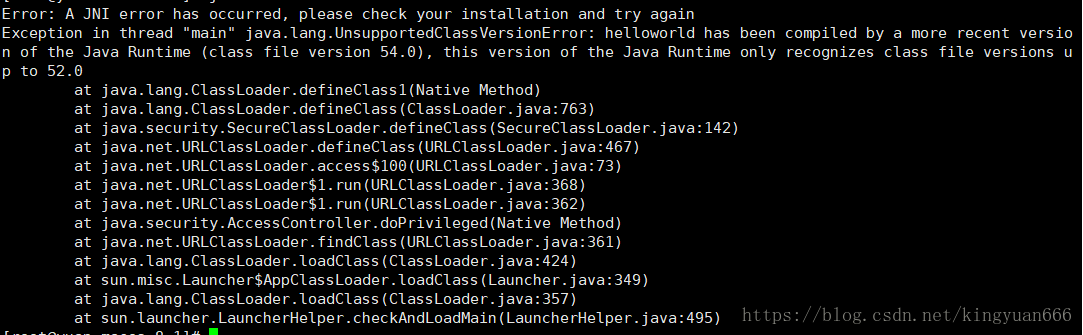
Error: a JNI error has occurred, please check your installation and try again

Java files do not report an error, but Java does report an error when it is run
Take a closer look at the error message
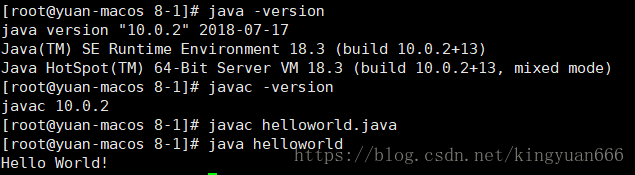
Exception in thread “main” java.lang.UnsupportedClassVersionError: The helloworld has had been compiled by a more recent version of the Java Runtime (class file version 54.0), and this version of the Java Runtime only recognizes the class file versions up to 52.0
Check the cause and find that the Java version is inconsistent with the JavAC version.
Java-version and Javac-Version, indeed
The two versions do not agree
Solution:
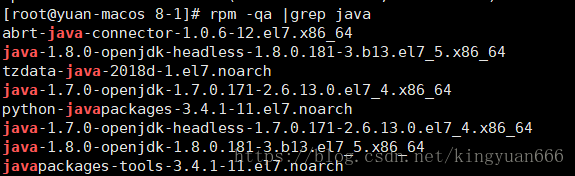
1. Query how many Java versions are in Linux

rpm -qa |grep java

2. Then delete them one by one

rpm -e --nodeps java-1.8.0-openjdk-headless-1.8.0.181-3.b13.el7_5.x86_64
rpm -e --nodeps java-1.7.0-openjdk-1.7.0.171-2.6.13.0.el7_4.x86_64
rpm -e --nodeps java-1.7.0-openjdk-headless-1.7.0.171-2.6.13.0.el7_4.x86_64
rpm -e --nodeps java-1.8.0-openjdk-1.8.0.181-3.b13.el7_5.x86_64 
(Enter rpm --e --nodeps + "existing version of java") Delete as many as you can.

3. Verify that all the original Java versions have been removed

[root@yuan 8-1]# java - version
-bash: /usr/bin/java: No such file or directory

4. Configure newly installed Java environment variables after the original version is removed

vi /etc/profile 

Edit the profile file and add it at the end

JAVA_HOME=/usr/local/java/jdk-10.0.2/   ###(“jdk-10.0.2" is changed to the name of the installation file of the java version you want to install.)
JRE_HOME=$JAVA_HOME/           ###(As there is no jre folder after jdk10 unzip, if it is below jdk10 version, you should
                               for“JRE_HOME=$JAVA_HOME/jre”)
PATH=$PATH:$JAVA_HOME/bin:$JRE_HOME/bin:$PATH
CLASSPATH=.:$JAVA_HOME/lib/dt.jar:$JAVA_HOME/lib/tools.jar:$JRE_HOME/lib:$CLASSPATH
export JAVA_HOME JRE_HOME PATH CLASSPATH

5. Last update

source /etc/profile

complete

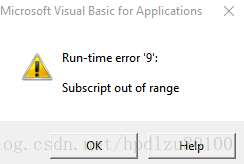
runtime error ‘9’: subscript out of range error in VBA programming

Question:
Today, in order to implement a seemingly simple function, it turned out that it took me nearly 3 hours to debug the VBA code, and I still haven’t finished a cup of coffee since I drank it in the morning.
Among them, encountered a “Runtime-error ‘9’” : Subscript out of range error, which delayed a lot of time.

Problem code:

With workbooks(fileName).VBProject
        For Each objVbc In .VBComponents
        Select Case objVbc.Type
            Case 1, 2, 3
                .VBComponents.Remove .VBComponents(objVbc.Name)
            Case Else
                With objVbc.CodeModule
                    .DeleteLines 1, .CountOfLines
                End With
        End Select
        Next
    End With

Solutions:
That’s the problem

workbooks(fileName).VBProject

This sentence. No error will be reported after modification to the following code:
Modified code:

Dim wkBook As Workbook      'VBA code (modules and worksheets) used to delete the delivery file.
Dim objVbc As Object        'Defining a VBA Component in a delivery file (VB Component)
    Set wkBook = GetObject(Filename)
    'Remove VBA codes from delivery files (users do not need to see these codes)
    With wkBook.VBProject
        For Each objVbc In .VBComponents
        Select Case objVbc.Type
            Case 1, 2, 3
                .VBComponents.Remove .VBComponents(objVbc.Name)
            Case Else
                With objVbc.CodeModule
                    .DeleteLines 1, .CountOfLines
                End With
        End Select
        Next
    End With
 

———————————————————————————————————-

Subscript out of range (Error 9)

Elements of arrays and members of collections can only be accessed within their defined ranges. This error has the following causes and solutions:

You referenced a nonexistent array element. The subscript may be larger or smaller than the range of possible subscripts, or the array may not have dimensions assigned at this point in the application. Check the declaration of the array to verify its upper and lower bounds. Use the UBound and LBound functions to condition array accesses if you’re working with arrays that are redimensioned. If the index is specified as a variable, check the spelling of the variable name. You declared an array but didn’t specify the number of elements. For example, the following code causes this error:

Dim MyArray() As Integer
MyArray(8) = 234    ' Causes Error 9.

Visual Basic doesn’t implicitly dimension unspecified array ranges as 0 – 10. Instead, you must use Dim or ReDim to specify explicitly the number of elements in an array. You referenced a nonexistent collection member. Try using the For Each… Next construct instead of specifying index elements. You used a shorthand form of subscript that implicitly specified an invalid element. For example, when you use the ! operator with a collection, the ! implicitly specifies a key. For example, object!keyname. value is equivalent to object.item(keyname).value. In this case, an error is generated if keyname represents an invalid key in the collection. To fix the error, use a valid key name or index for the collection.

For additional information, select the item in question and press F1 (in Windows) or HELP (on the Macintosh).

Error. Onload failed when ‘rjava’ was calculated in loadnamespace()

64-bit Windows in installing rJava and Rwordseg times errors as well as solutions, the detailed procedure is as follows.

> install.packages('rJava')
--- Use the CRAN mirror for this connection phase ---.
试开URL’http://mirrors.xmu.edu.cn/CRAN/bin/windows/contrib/3.1/rJava_0.9-7.zip'
Content type 'application/zip' length 761221 bytes (743 KB)
The URL is open.
downloaded 743 KB

Package 'rJava' opened successfully, MD5 and check also passed.

The downloaded binary package is available in the
        C:\Users\asus\AppData\Local\Temp\RtmpUT48J3\downloaded_packages

There is no problem installing rJava through install.packages(‘ rJava ‘).

> library(rJava)
Error : loadNamespace().onLoad failed when calculating 'rJava', details.
  Call: inDL(x, as.logical(local), as.logical(now), ...)
  Error: Unable to load shared target 'C:/Program Files/R/R-3.1.3/library/rJava/libs/i386/rJava.dll'::
  LoadLibrary failure: %1 Not a valid Win32 application.

Error: 'rJava' programming package or namespace failed to load.

RJava loading error: The R client USES Windows 32bit, the operating system version is 64bit, and the system installed Java is 64bit, which is not compatible with rJava.

C:\Users\asus>java -version
java version "1.8.0_45"
Java(TM) SE Runtime Environment (build 1.8.0_45-b14)
Java HotSpot(TM) **64-Bit** Server VM (build 25.45-b02, mixed mode)

The solution, using a 32-bit JRE, is to reset the environment variable.

> Sys.setenv(JAVA_HOME='C:\\Program Files (x86)\\Java\\jre6')
> library('rJava')

Resetting the environment variables before loading rJava, OK

> install.packages("Rwordseg", repos = "http://R-Forge.R-project.org", type = "source")
试开URL’http://R-Forge.R-project.org/src/contrib/Rwordseg_0.2-1.tar.gz'
Content type 'application/x-gzip' length 5445754 bytes (5.2 MB)
打开了URL
downloaded 5.2 MB

* installing *source* package 'Rwordseg' ...
** R
** demo
** inst
** preparing package for lazy loading
** help
*** installing help indices
** building package indices
** testing if installed package can be loaded
*** arch - i386
2015-8-31 11:34:07 org.ansj.util.MyStaticValue <clinit>
Warning: not find library.properties in classpath use it by default !
2015-8-31 11:34:08 org.ansj.library.UserDefineLibrary loadLibrary
Warning: init userLibrary  waring :library/default.dic because : not find that file or can not to read !
2015-8-31 11:34:08 org.ansj.library.UserDefineLibrary initAmbiguityLibrary
Warning: init ambiguity  waring :library/ambiguity.dic because : not find that file or can not to read !
2015-8-31 11:34:08 org.ansj.library.UserDefineLibrary loadFile
Message: init user userLibrary ok path is : C:\Program Files\R\R-3.1.3\library\Rwordseg\config\userdic
2015-8-31 11:34:09 org.ansj.library.InitDictionary init
Message: init core library ok use time :1570
2015-8-31 11:34:11 org.ansj.library.NgramLibrary <clinit>
Message: init ngram ok use time :1492
*** arch - x64
Agu 31, 2015 11:34:14 上午 org.ansj.util.MyStaticValue <clinit>
Warning: not find library.properties in classpath use it by default !
Agu 31, 2015 11:34:14 上午 org.ansj.library.UserDefineLibrary loadLibrary
Warning: init userLibrary  waring :library/default.dic because : not find that file or can not to read !
Agu 31, 2015 11:34:14 上午 org.ansj.library.UserDefineLibrary initAmbiguityLibrary
Warning: init ambiguity  waring :library/ambiguity.dic because : not find that file or can not to read !
Agu 31, 2015 11:34:14 上午 org.ansj.library.UserDefineLibrary loadFile
Message: init user userLibrary ok path is : C:\Program Files\R\R-3.1.3\library\Rwordseg\config\userdic
Agu 31, 2015 11:34:15 上午 org.ansj.library.InitDictionary init
Message: init core library ok use time :1107
Agu 31, 2015 11:34:16 上午 org.ansj.library.NgramLibrary <clinit>
Message: init ngram ok use time :675
* DONE (Rwordseg)

The downloaded package is available in the
        ‘C:\Users\asus\AppData\Local\Temp\RtmpUT48J3\downloaded_packages’
> library(Rwordseg)
# Version: 0.2-1       

Installation of Rwordseg is complete.
One thing to note here is the version of the JRE. Make sure it’s 32-bit.

git error: The following untracked working tree files would be overwritten by checkout

Git resolves an error: The following untracked working tree files would be overwritten by checkout
December 27, 2017 12:09:50
Reading count: 1,792
When switching branches in IDEA, such an error occurred, resulting in The failure to switch properly: error: The following untracked working tree files would be overwritten by checkout
According to the error message, the problem is caused by some untracked working tree files. So just solving these untracked files solves this problem.
Solutions:
Open SourceTree through the command line, enter the local version warehouse directory, directly executed

git clean -d -fx

Can. Git clean-d-fx means: delete files that don’t have Git add; git clean-fx means: delete files that don’t have Git add.
Git clean parameters
-n displays files and directories to be deleted;
-x – Deleting ignored files is no longer recognized by Git
-D — Deletes files that have not been added to Git’s path
— F — Forced operation
Git clean – n
Git clean – df
Git clean – f

IIS 404 The page cannot be displayed because an internal server error has occurred

1. allow physical paths in the ApplicationHost. Configuration File

By default, this file is located in %SystemRoot%\system32\inetsrv\config.

Find this file and edit it.

Search for section < httperror…than;

Then add the command allowAbsolutePathsWhenDelegated=”true”, as follows:

<httpErrors lockAttributes="allowAbsolutePathsWhenDelegated,defaultPath" allowAbsolutePathsWhenDelegated="true">
   ....
   ....
</httpErrors>


Error getting authority: Error initializing authority: Could not connect: No such file or directory

When I was using the Intranet GitLAB warehouse this morning, I found that the page could not be opened and SSH could not be connected.
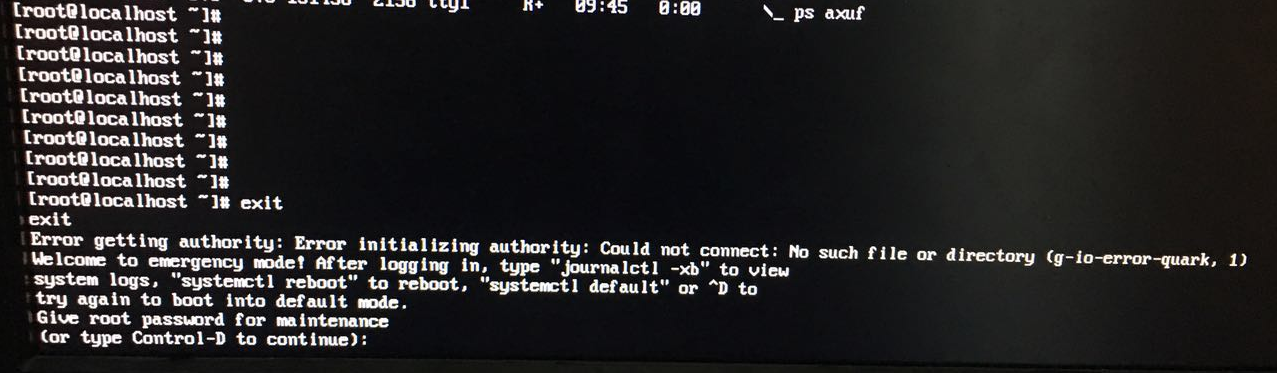
Connected to the monitor in the machine room, the following errors were found:

Error getting authority: Error initializing authority: Could not connect: No such file or directory (g-io-error-quark, 1)


Enter the root password to enter the shell interface.
As prompted, use the command to view the log

# journalctl -xb -p3
-- Logs begin at Tue 2017-09-05 09:34:14 CST, end at Tue 2017-09-05 10:15:57 CST. --
.... Omitted content
Sep 05 09:34:18 localhost.localdomain kernel: :megaswr[ahci]: polling for interrupt status timed out for port=1, slot=0
Sep 05 09:34:18 localhost.localdomain kernel: :megasr[ahci]: warning PortReset called for port[1]
Sep 05 09:34:18 localhost.localdomain kernel: :megasr[ahci]: device on port:[1] online:[0x133] [0] milliseconds after reset
Sep 05 09:34:25 localhost.localdomain kernel: :megaswr[ahci]: polling for interrupt status timed out for port=1, slot=0
Sep 05 09:34:25 localhost.localdomain kernel: :megaswr[ahci]:Trouble port=1, slot=0
Sep 05 09:34:25 localhost.localdomain kernel: :megaswr[osl]: breakpoint called
Sep 05 09:34:25 localhost.localdomain kernel: :megasr[ahci]: Device:[2:INTEL SSDSC2BW48] NCQ:[Yes] Queue Depth:[0x20] capacity=0x37e436b0
Sep 05 09:34:25 localhost.localdomain kernel: :megasr[ahci]: Device:[3:INTEL SSDSC2BW48] NCQ:[Yes] Queue Depth:[0x20] capacity=0x37e436b0
Sep 05 09:34:25 localhost.localdomain kernel: :megasr[ahci]: Device:[4:ST9500620NS     ] NCQ:[Yes] Queue Depth:[0x20] capacity=0x3a386030
Sep 05 09:34:25 localhost.localdomain kernel: :megasr[ahci]: Device:[5:ST9500620NS     ] NCQ:[Yes] Queue Depth:[0x20] capacity=0x3a386030
Sep 05 09:34:25 localhost.localdomain kernel: :megasr: raid 10 logical drive is degraded, is not initialized, has 2 spans, and has a size of 0x6f869000 sectors
Sep 05 09:34:25 localhost.localdomain kernel: :megasr: raid 1 logical drive is online, is not initialized, has 2 drives, and has a size of 0x3a175800 sectors.
Sep 05 09:34:25 localhost.localdomain kernel: :megasr[raid_key]: [ ] RAID5 support    [ ] SAS drive support
Sep 05 09:35:57 localhost.localdomain systemd[1]: Timed out waiting for device dev-sdc1.device.

In the logs, you see a problem with the Dev-SDC1 device.
View disk partitions

# fdisk  -l

Disk /dev/sdb: 499.0 GB, 498999492608 bytes, 974608384 sectors
Units = sectors of 1 * 512 = 512 bytes
Sector size (logical/physical): 512 bytes/512 bytes
I/O size (minimum/optimal): 512 bytes/512 bytes
Disk label type: dos
Disk identifier: 0xfcae2784

   Device Boot      Start         End      Blocks   Id  System
/dev/sdb1            2048  1949216767   974607360   83  Linux
WARNING: fdisk GPT support is currently new, and therefore in an experimental phase. Use at your own discretion.

Disk /dev/sda: 958.0 GB, 957997907968 bytes, 1871089664 sectors
Units = sectors of 1 * 512 = 512 bytes
Sector size (logical/physical): 512 bytes/512 bytes
I/O size (minimum/optimal): 512 bytes/512 bytes
Disk label type: gpt


#         Start          End    Size  Type            Name
 1         2048       411647    200M  EFI System      EFI System Partition
 2       411648       821247    200M  Microsoft basic 
 3       821248   1871087615  891.8G  Linux LVM       

Disk /dev/mapper/cl-root: 946.8 GB, 946834767872 bytes, 1849286656 sectors
Units = sectors of 1 * 512 = 512 bytes
Sector size (logical/physical): 512 bytes/512 bytes
I/O size (minimum/optimal): 512 bytes/512 bytes


Disk /dev/mapper/cl-swap: 10.7 GB, 10737418240 bytes, 20971520 sectors
Units = sectors of 1 * 512 = 512 bytes
Sector size (logical/physical): 512 bytes/512 bytes
I/O size (minimum/optimal): 512 bytes/512 bytes

Obviously, the SDC is gone. I just remember that when I installed the system, I inserted an extra USB flash disk. At that time, the USB flash disk was identified as SDB and this disk was identified as SDC.
Check out fSTAB to prove it.

# cat /etc/fstab 

#
# /etc/fstab
# Created by anaconda on Tue Aug  8 13:10:48 2017
#
# Accessible filesystems, by reference, are maintained under ‘/dev/disk‘
# See man pages fstab(5), findfs(8), mount(8) and/or blkid(8) for more info
#
/dev/mapper/cl-root    /                      xfs     defaults        0 0
UUID=a51fd6f8-a756-4e8f-ba44-5589fb99861e /boot                   xfs     defaults        0 0
UUID=7D74-6C54          /boot/efi               vfat    umask=0077,shortname=winnt 0 0
/dev/mapper/cl-swap     swap                    swap    defaults        0 0
/dev/sdc1 /data ext4 defaults 0 0

It looks like you are changing the name of the disk you are writing to UUID.

# blkid 
/dev/sdc1: UUID="ab4c28b5-1708-483c-973a-40f91d320a9d" TYPE="ext4" 
...

The modified FSTAB is

# cat /etc/fstab 

#
# /etc/fstab
# Created by anaconda on Tue Aug  8 13:10:48 2017
#
# Accessible filesystems, by reference, are maintained under ‘/dev/disk‘
# See man pages fstab(5), findfs(8), mount(8) and/or blkid(8) for more info
#
/dev/mapper/cl-root    /                      xfs     defaults        0 0
UUID=a51fd6f8-a756-4e8f-ba44-5589fb99861e /boot                   xfs     defaults        0 0
UUID=7D74-6C54          /boot/efi               vfat    umask=0077,shortname=winnt 0 0
/dev/mapper/cl-swap     swap                    swap    defaults        0 0
UUID=ab4c28b5-1708-483c-973a-40f91d320a9d /data ext4 defaults 0 0

Try to restart daemon, same error still pops up.

# systemctl daemon-reload
Error getting authority. Error initializing authority: Could not connect: No such file or directory  (g-io-error-quark, 1)

Exit the shell and the error pops up again.

Error getting authority: Error initializing authority: Could not connect: No such file or directory (g-io-error-quark, 1)

Never mind, wait a few seconds, the system is ready to start normally.

How to Fix Microsoft SQL Server Error 1326

When using SQL Server, we all encounter the problem that we cannot connect to the remote database instance using SQL Server Management Studio. The error description information is summarized as follows:
An error has contracted a connection to the server.
(provider: Named Pipes provider, error: 40 — Could not open a connection to SQL server)
An error has been sent to the server. 5)
An error has occurred while establishing a connection to the server. When connecting to SQL Server 2005, this failure may be caused by the fact that under the default settings SQL Server does not allow remote connections. (provider: Named Pipes Provider, error: 40 — Could not open a connection to SQL Server (Microsoft SQL Server, 1326)
— Could not open a connection to SQL Server (Microsoft SQL Server, 1326)
) In fact, this is a more typical database server setup problem, in the LAN or wan may be encountered, we only need to do some configuration of the database server can solve this problem, to see the specific steps.

The reason is that I modified the computer name and logged in with the original user name, so the above error occurred.
The solution is to re-search the SQL Server server and log in.

Gog cannot link PSN: the connection to the server timed out

Trying to pick up Wizard 3 on the GOG Galaxy, only to find that the connection to PSN keeps coming up after endless clicks to verify the image
“The Connection to The server Timed out.”
Solutions:
1. Turn off the running GOG Galaxy.
2. Log in to PSN with the browser (if logged in, log out, log in again).
3. After login, click on the link: https://ca.account.sony.com/api/v1/ssocookie (this link is to look at SONY’s cookies, don’t be afraid to trust point).
You will see

{"npsso":"xxx"}

XXX is the value of nPSSO, copy it down (without quotes).
4. Open my computer and type in the address bar:

%LocalAppData%\GOG.com\Galaxy\plugins\installed\

Open the “psn_xxxxxxxx_xxx…” Folders (unique folders). Find plugin.py and open it with any text editor.
5. Find line 64 and you will see:

stored_npsso = stored_credentials.get("npsso") if stored_credentials else None

Delete all of the equals sign and copy the nPSSO value into it. Be careful to switch to the English input method and include the value in double quotation marks.

stored_npsso = "Your npsso Key"

Save the change (CTRL + S) and close the file.
6. Restart GOG Galaxy and connect to PSN again.

[619]libgtk-3.so.0 or libXt.so.6: cannot open shared object file: No such file or directory

libgtk-3.so.0 or libXt.so.6: cannot open shared object file: No such file or directory

Error Message:

[root@test firefox]# firefox 

XPCOMGlueLoad error for file /usr/lib64/firefox/libmozgtk.so:
libgtk-3.so.0: cannot open shared object file: No such file or directory
Couldn't load XPCOM.

Solutions:
1. Uninstall firefox:

yum romove firefox

2. Install GTK3

yum install gtk3

3. Download the latest Firefox installation

wget https://download-ssl.firefox.com.cn/releases/firefox/60.0/zh-CN/Firefox-latest-x86_64.tar.bz2

Tar: tar-xjvf Firefox-latest-x86_64. Tar. Bz2
The unzipped file is Firefox
4. Set environment variables
Modify configuration file

vim /etc/profile

Add at the end

PATH=$PATH:/usr/local/firefox   #/usr/local/firefoxThe path for firefox after unzipping
export PATH

: wq! Exit file
execution

source /etc/profile

libXt.so. 6: cannot open shared object file: No such file or directory

[root@crawl-01 bin]# firefox -v
XPCOMGlueLoad error for file /usr/lib64/firefox/libxul.so:
libXt.so.6: cannot open shared object file: No such file or directory
Couldn't load XPCOM.

Solution:

yum install libXt*  Install the appropriate package
rpm -qa | grep libXt Check the installed packages to see if the number is full.

Note: you cannot install with rpm-uvh libXt*. This installation mode will have packet dependency error, even if you install interdependent packages together. The reason is that RPM does not solve the problem of packet dependency
Reference: https://blog.csdn.net/chief_victo/article/details/80424987
https://blog.csdn.net/u012359618/article/details/51199170